How finisher medals are made, from sketch to ribbon
Updated · 6 min read
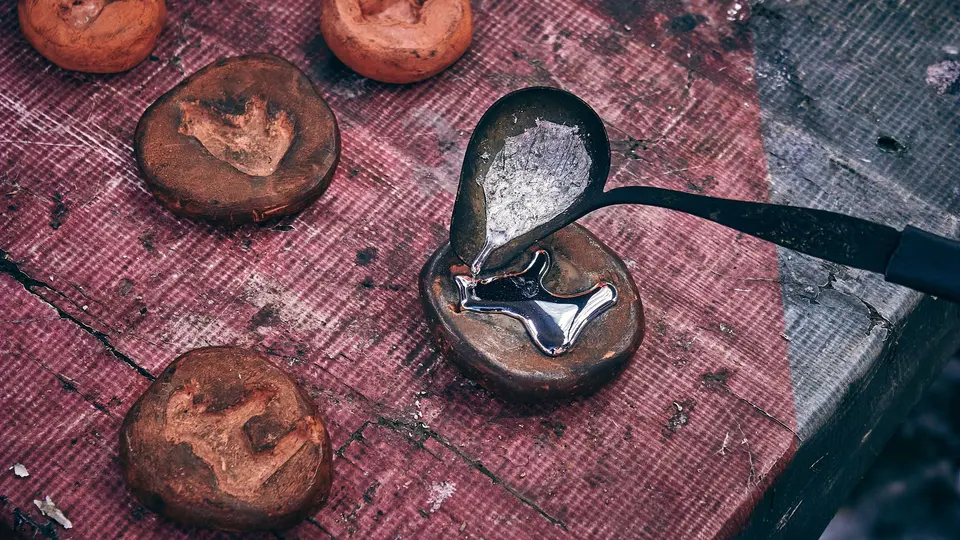
In short: Most finisher medals start as a flat design that is sculpted in 3D and cut into a steel die. The metal is then either die-cast, with molten alloy forced into the die, or stamped from a flat blank. The rough medal is trimmed and polished, plated in gold, silver or bronze, often darkened for an antique look, then filled with enamel. A ribbon is printed and attached, and each medal is checked and boxed. Casting allows deeper relief and odd shapes.
The steps at a glance
- Design: front, back, ribbon and box, drawn flat.
- Sculpt: the design turned into a 3D model with depth.
- Die: the model cut into hardened steel.
- Casting or stamping: metal shaped by the die.
- Trimming and polishing: the rough edges taken off.
- Plating and antiquing: the surface colour and finish.
- Enamel: colour filled into chosen areas and cured.
- Assembly: moving parts, ribbon and box.
- Inspection: each medal checked before it ships.
Design and the die
Everything starts with artwork. A good medal is designed in layers from the start, because relief is the point: what is raised, what is recessed, and where colour goes. The designer marks each enamel area and decides what the back shows.
The artwork is sculpted in 3D, often digitally, and the sculpt is cut into a steel die. The die is the expensive part. It is made once and used for every medal in the run, which is why medal makers set minimum orders and why a custom design costs more for a small event.
Die-casting or stamping
Die-casting injects molten metal, usually a non-ferrous alloy, into a reusable steel die under high pressure and holds it there until it sets. Zinc-based alloys are widely used for medals, since they fill fine detail well. Casting can produce deep relief, undercuts, cut-out windows and shapes that are not round.
Stamping, or die-striking, presses a flat blank of brass, copper or iron between two dies with a heavy press. It gives sharp, clean detail, but only as deep as the metal can be pushed. That is why stamped medals are usually round, thinner and shallower.
| Die-cast | Stamped (die-struck) | |
|---|---|---|
| Metal | Molten alloy poured into the die | A flat blank pressed in the die |
| Relief | Deep, layered, sculptural | Shallow and crisp |
| Shapes | Any outline, with cut-outs | Mostly round or simple |
| Feel | Thick and heavy | Thinner and lighter |
Trimming, polishing and plating
A cast medal comes out of the die with thin flaps of metal where the halves of the die met. These are trimmed and the edges polished. The medal is then plated: a thin layer of gold, silver, nickel or bronze colour is bonded to the surface.
An antique finish adds a dark tone over the plating, then the high points are buffed back to bright. The recesses stay dark and the raised parts catch the light, so the relief reads from across a room. Some makers finish this by hand, which is why no two antique medals look exactly alike.
Enamel: soft, hard and cloisonné
Colour is added after plating. Each enamel colour fills its own recessed area, separated by raised metal lines, and is cured. How it is finished decides the type.
| Type | How it is done | Result |
|---|---|---|
| Soft enamel | Filled and cured below the metal lines | Textured, with raised metal edges you can feel |
| Hard enamel | Overfilled, then ground and polished flat | Smooth and glossy, flush with the metal |
| Cloisonné | Colour set in cells between fine metal lines | The most detailed, with clean lines between colours |
| Glow-in-the-dark | A phosphorescent enamel in chosen areas | Charges in light and glows after dark |
| Translucent | Clear coloured enamel over textured metal | The metal pattern shows through |
Traditional cloisonné is an old craft: fine wires are bent into the outline of the design and fixed to the metal, and these cells, the cloisons, are filled with coloured enamel. In the medal trade the word is also used for detailed enamel set between raised cast lines.
Moving parts, ribbons and boxes
Spinners, hinges, magnets and sliding pieces are made as separate parts and assembled after enamel. A well-made moving part sits in a recess cast for it. A cheap one is glued on.
Ribbons are often printed by dye-sublimation, where the design is heat-transferred into the fabric, so colours and patterns can match the medal. The ribbon is sewn to a clip or a loop. Last, each medal is checked, bagged and boxed.
What can go wrong, and what to check
- Enamel spills over a metal line, or leaves a gap at the edge.
- Small bubbles or pits in the enamel surface.
- Plating worn through on the high points, showing a different metal underneath.
- Rough edges where the casting was not trimmed cleanly.
- A ribbon loop bent or a jump ring opened in transit.
Look at a new medal under a lamp at an angle. Small variation in an antique finish is normal. Spills, bubbles and bare metal are not, and a good seller will replace them.
Why some medals cost more than others
- The die. A new steel die for each design, front and back, is a fixed cost spread across the run.
- Casting rather than stamping, and thicker metal.
- The number of enamel colours. Each colour is a separate fill.
- Hand finishing, such as an antique patina buffed by hand.
- Moving parts, magnets and special enamel like glow-in-the-dark.
- A ribbon printed for the medal, and a rigid gift box rather than a plastic bag.
A medal that does all of these will cost more than a stamped disc on a stock lanyard. Whether that is worth it depends on whether you want a keepsake or a souvenir.
How X Challenge medals are made
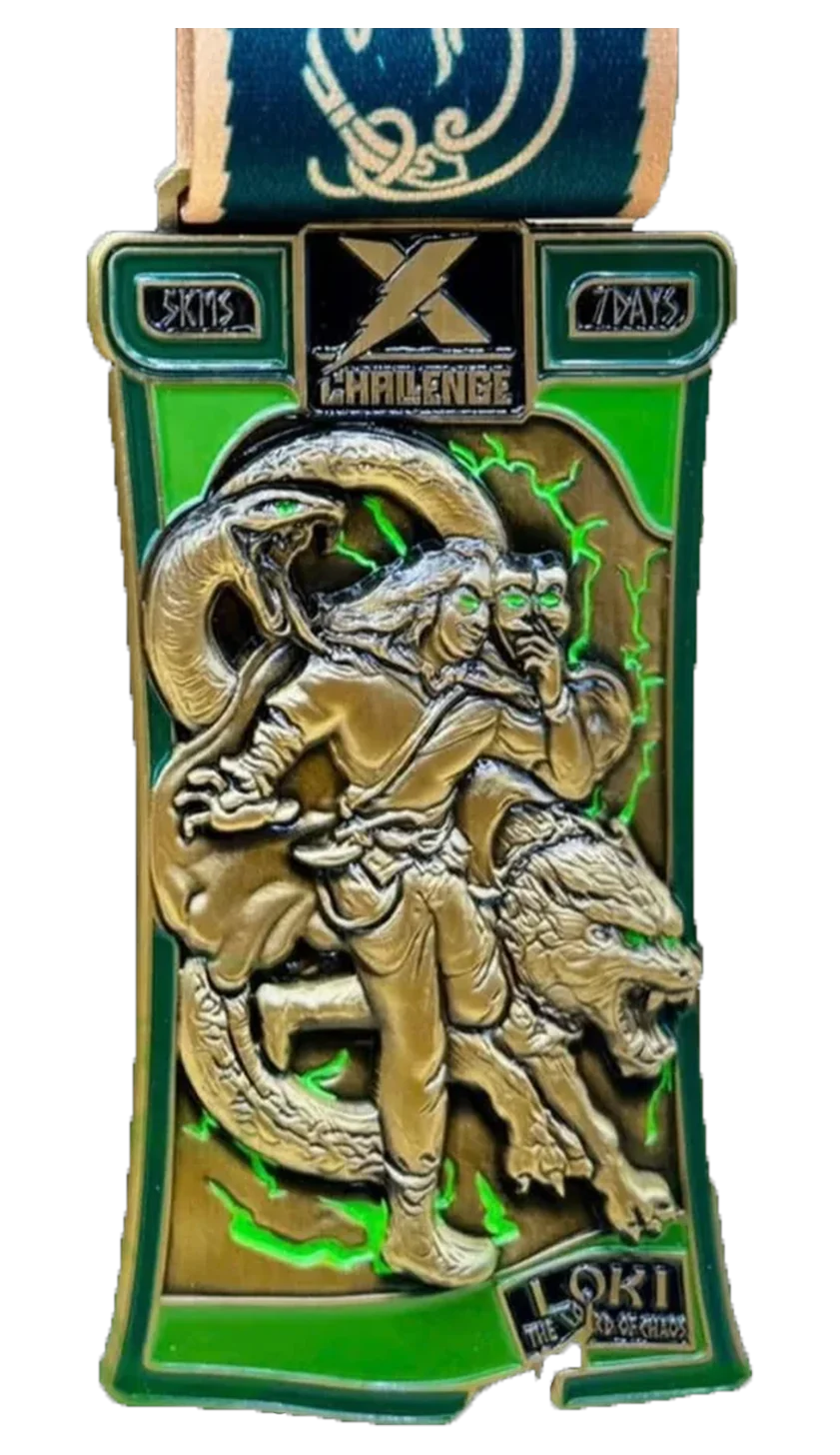
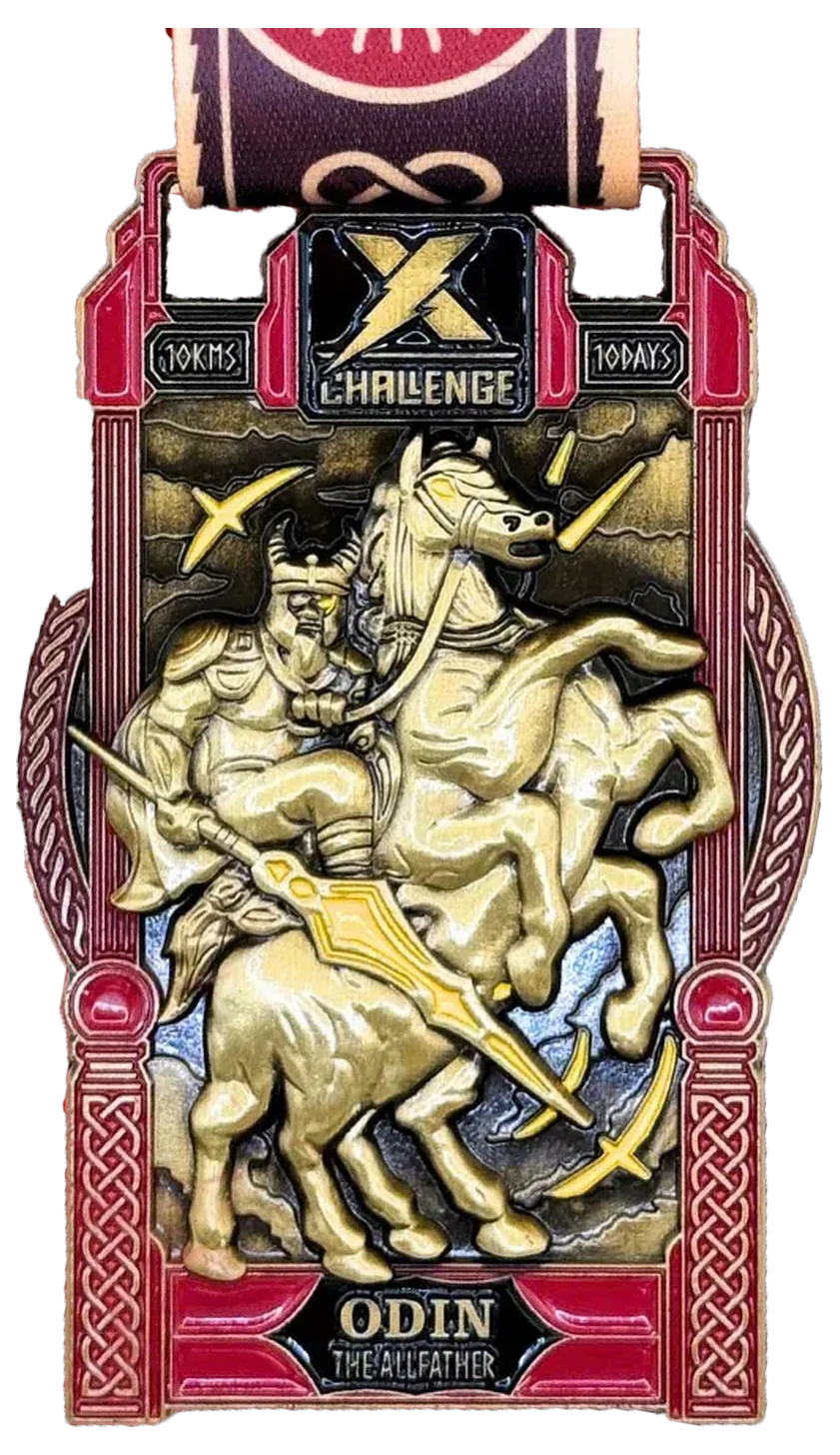
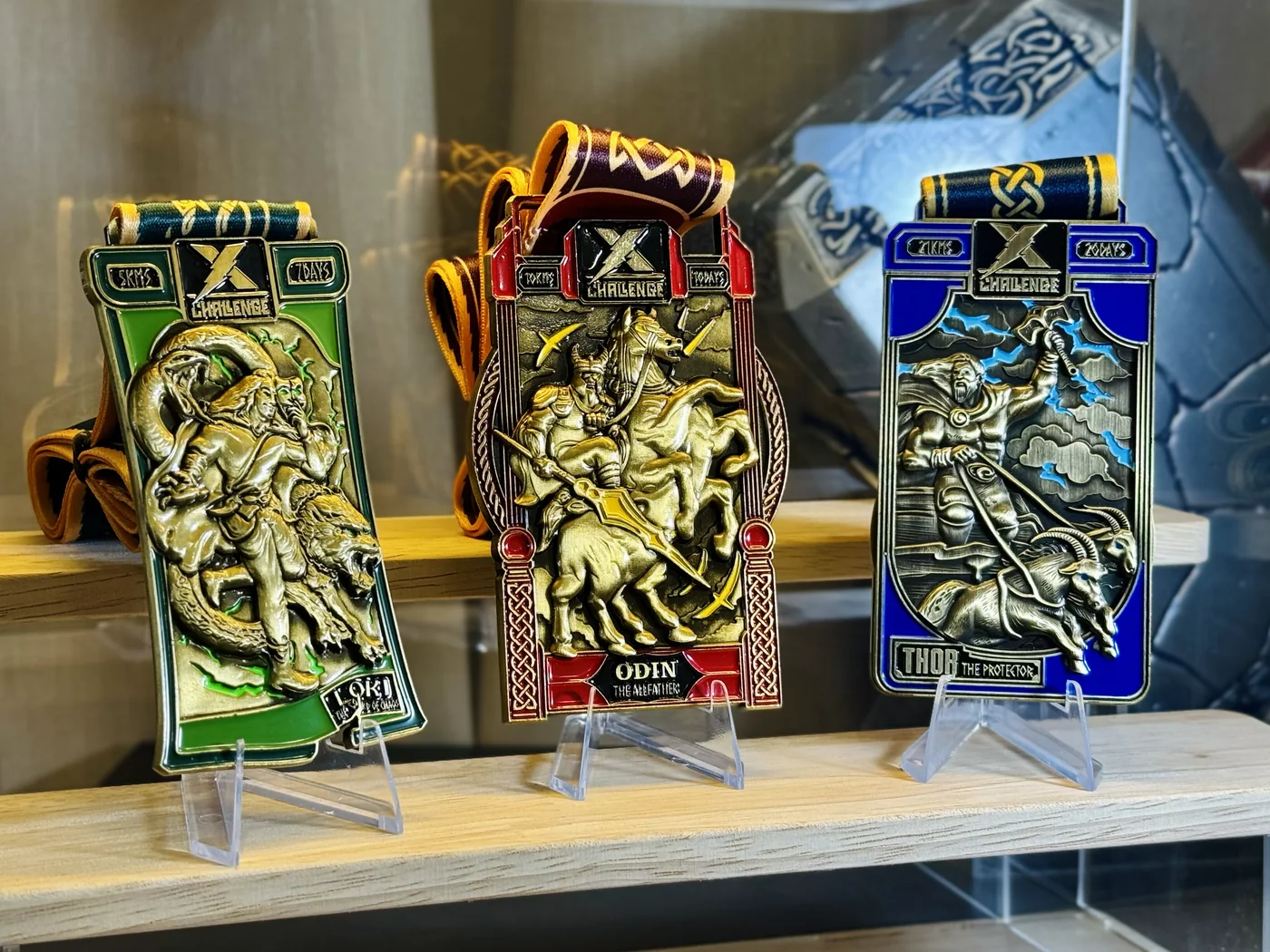
The three Legends Of Asgard medals are die-cast alloy with a hand-finished antique bronze patina in deep relief. THOR has electric-blue enamel lightning, ODIN has crimson and blue knotwork enamel and an eye held on two magnets, and LOKI uses glow-in-the-dark green enamel. Each comes with a Norse knotwork ribbon and a gift box.
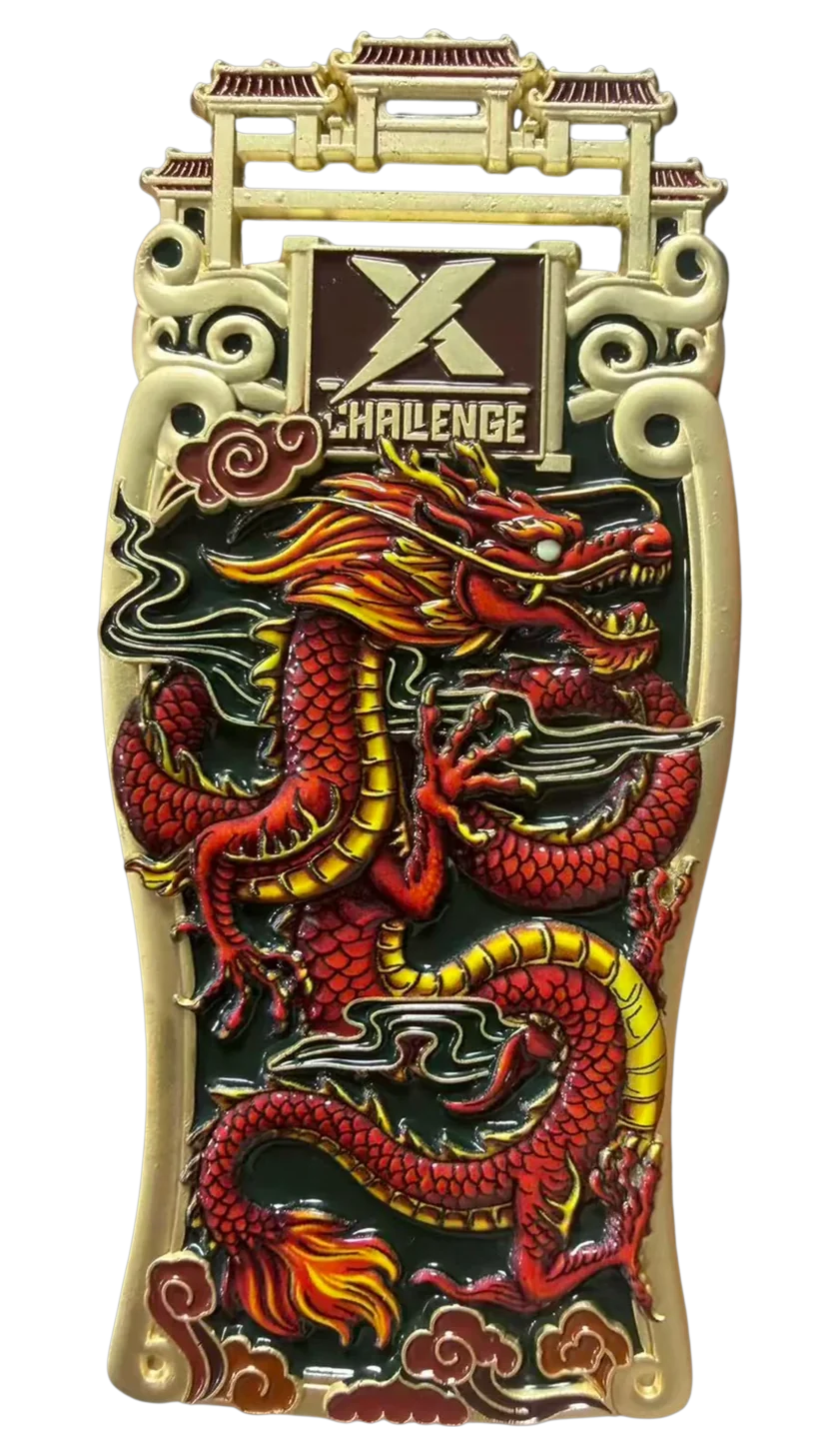
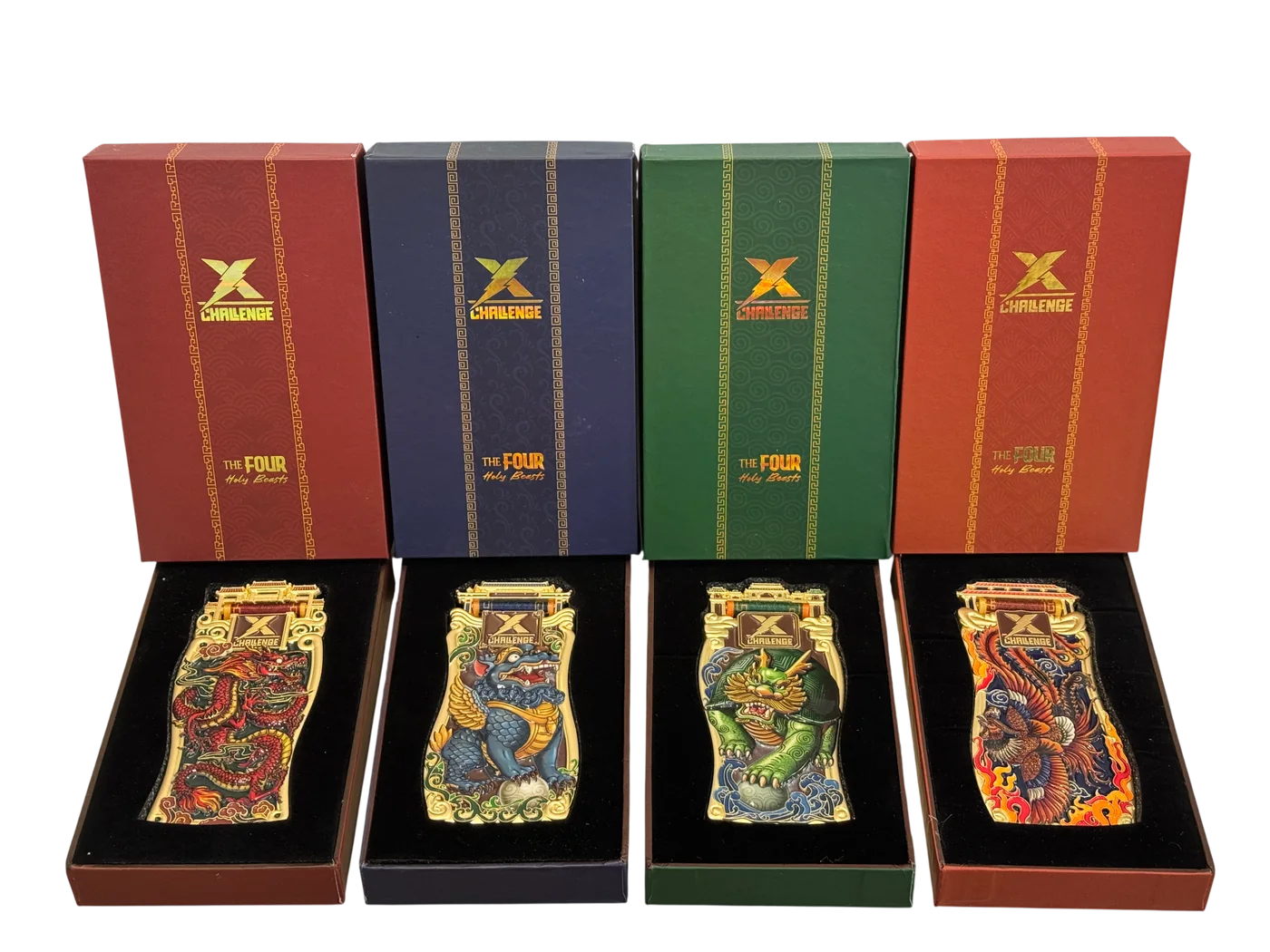
The four The Four Holy Beasts medals are die-cast as temple steles under a tiled pagoda roof, with cloisonné enamel on the face and relief on the back: carved jade-tone for DRAGON, gilt for KYLIN and TURTLE, burnished metal for PHOENIX. They come with a satin ribbon and a gift box. Every X Challenge medal carries your distance struck into the metal. Medals ship within the 50 US states, 5–10 business days after the app records the finish, by USPS or UPS with tracking.
Common questions
- What metal are finisher medals made of? Most die-cast medals are a zinc-based alloy, plated to look like gold, silver or bronze.
- Are gold medals real gold? Almost never on a finisher medal. The colour is plating.
- What is the difference between soft and hard enamel? Soft enamel sits below the metal lines. Hard enamel is polished flat.
- Why do custom medals have minimum orders? The steel die costs the same whether you make fifty medals or five thousand.
Sources
- Die casting, IEEE Technology Navigator: molten non-ferrous alloy injected under high pressure into a reusable steel die.
- Cloisonné workshop, The Guild of Enamellers: fine wires bent to the design, forming cells filled with coloured enamels.
Challenges from this guide
Or take the whole set
More: all guides · how it works · every challenge