
Yggdrasil and the nine realms of Norse mythology
Updated · 6 min read
In short: Yggdrasil is the world tree of Norse mythology, a giant ash whose branches spread over all the worlds and whose three roots reach the gods, the giants and the misty underworld. The nine realms hang in it, among them Asgard for the gods, Midgard for people and Jotunheim for the giants. Wells lie under its roots, an eagle sits at the top, and a dragon gnaws below. At Ragnarök the tree shakes, but the world rises again.
The world tree
The poem Völuspá opens its description simply: “An ash I know, Yggdrasil its name.” It is always green, watered from a holy well, and dew falls from it into the valleys. The Prose Edda calls it the best and greatest of all trees, with branches spreading over the world and reaching above heaven. The gods meet beneath it every day to hold court.
The name is usually read as “Ygg’s horse”. Ygg, “the Terrible”, is one of Odin’s names, and the horse is the tree he hung on to win the runes.
The nine realms
The seeress in Völuspá says she remembers “nine worlds” in the tree. The poems never list all nine in one place, and scholars reconstruct them from different texts. A common list:
| Realm | Who lives there |
|---|---|
| Asgard | The Æsir, the main family of gods, including Odin and Thor |
| Vanaheim | The Vanir, gods of fertility and wealth |
| Alfheim | The light elves |
| Midgard | People: the middle world, ringed by the sea and the serpent Jörmungandr |
| Jotunheim | The giants |
| Muspelheim | Fire, and the fire giant Surtr |
| Svartalfheim | The dark elves |
| Niflheim | Mist, cold and the dead |
| The ninth | Uncertain: often given as the home of the dwarfs |
The translator Henry Adams Bellows gives this list in his notes and says plainly that the ninth is uncertain. Treat any neat diagram of the nine realms as a modern reconstruction.
The roots and the wells
In the Prose Edda, three roots hold the tree up. One reaches the gods. One reaches the frost giants, and under it is the well of Mímir, where wisdom is hidden. The third reaches Niflheim, and under it is the spring Hvergelmir, where the dragon Níðhöggr gnaws the root from below.
Odin gave one of his eyes as a pledge for a single drink from Mímir’s well. The third well, Urd’s, is where three wise women, the Norns, live. Völuspá names them Urd, Verdandi and Skuld, and they shape the lives of people.
Who lives in the tree
- An eagle in the top branches, who knows many things, with a hawk called Vedrfölnir sitting between its eyes.
- Ratatoskr, a squirrel who runs up and down the trunk carrying spiteful words between the eagle and the dragon.
- Four stags who leap in the branches and bite the leaves.
- Níðhöggr, the dragon at the root, with more serpents than anyone can count.
The tree suffers. The Prose Edda quotes a verse saying Yggdrasil bears more hardship than people know: stags bite it above, it rots at the side, and the dragon gnaws beneath. It survives anyway.
An easy way to remember the realms
Modern retellings often stack the realms in three levels, which is a handy memory aid even though the Eddas never draw it so neatly.
- Up high: Asgard, Vanaheim and Alfheim, the homes of the gods and the light elves.
- In the middle: Midgard for people, Jotunheim for the giants, and the dark places of the elves and dwarfs.
- Down below: Niflheim, cold and dark, where the dead go, and Muspelheim, the world of fire.
Bifröst links the gods’ realm to the middle world, and the roots of the tree reach down to the lowest one. Fire and ice sit at opposite ends. In the Prose Edda, the world itself began where the heat of Muspelheim met the cold of Niflheim.
Odin on the tree
The most famous story about Yggdrasil belongs to Odin. In Hávamál he says he hung on “the windy tree” for nine nights, wounded by his own spear, given to himself, with no food or drink, until he looked down and took up the runes. The runes are the old Norse letters, and for the poets they carried power as well as sounds. Odin pays for knowledge with pain, just as he pays for wisdom with an eye.
It is one of the strangest scenes in the myths: a god sacrificing himself to himself, on the tree that holds the whole world. It also explains why runes, ravens and the tree so often appear together in Norse art.
Bifröst, the bridge between worlds
The gods built a bridge from earth to heaven called Bifröst. The Prose Edda says you may know it as the rainbow, that it has three colours, and that it is very strong. Heimdall watches over it. But it will break when the fire giants of Muspelheim ride over it at the end of the world, because nothing can stand against them.
Yggdrasil at Ragnarök
In Völuspá, the end begins with Heimdall’s horn. Then “Yggdrasil shakes”, the old limbs groan and the wolf breaks free. Fire rises to the sky and the earth sinks into the sea. The tree is not destroyed in the poem. Two people, Líf and Lífþrasir, hide in a wood often read as Yggdrasil itself and come out to start again. The seeress sees the earth rise from the waves, green once more.
Yggdrasil on the ODIN medal
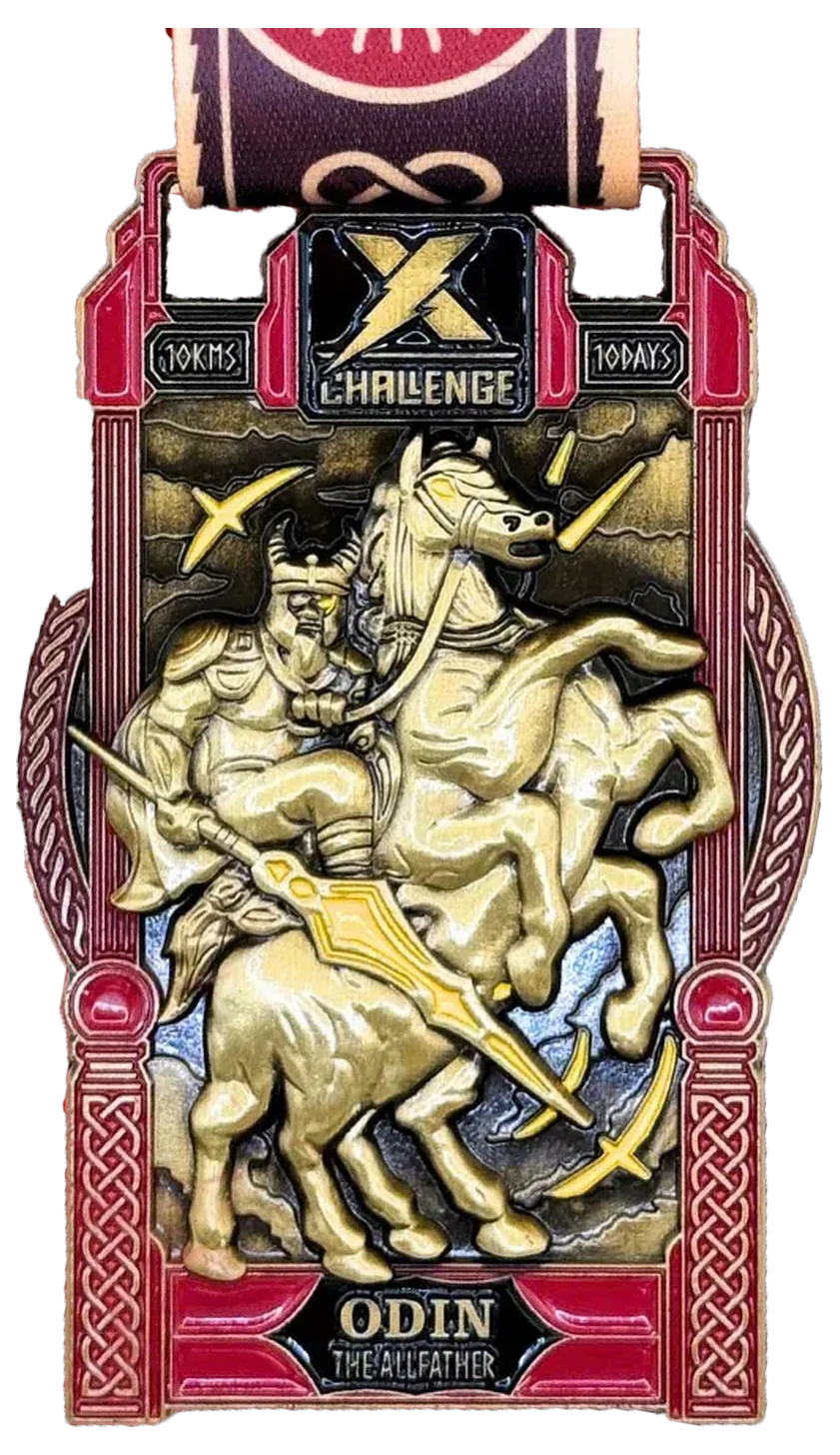
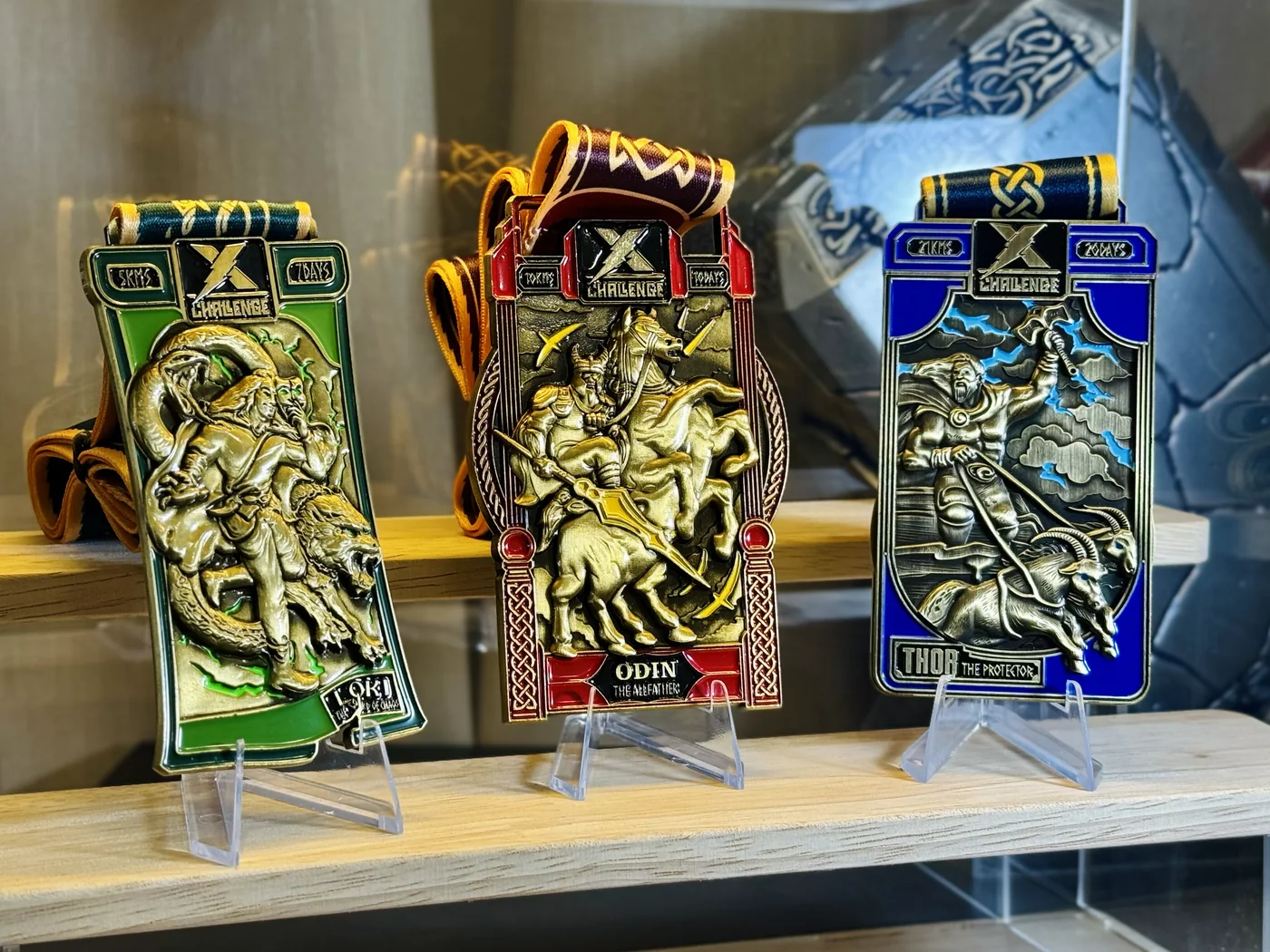
The reverse of ODIN is titled “Origin of the Nine Realms”. It shows Yggdrasil from root to crown, with an old rune charm cut into the roots and the eye Odin paid with set into the canopy. The eye lifts off on two magnets, and beneath it Huginn and Muninn stand either side of the Valknut. 10 km (6.2 miles) in 10 days is about 1 km a day, run or walked, and it is the middle medal of Legends Of Asgard. For the gods themselves, read who Odin, Thor and Loki are.
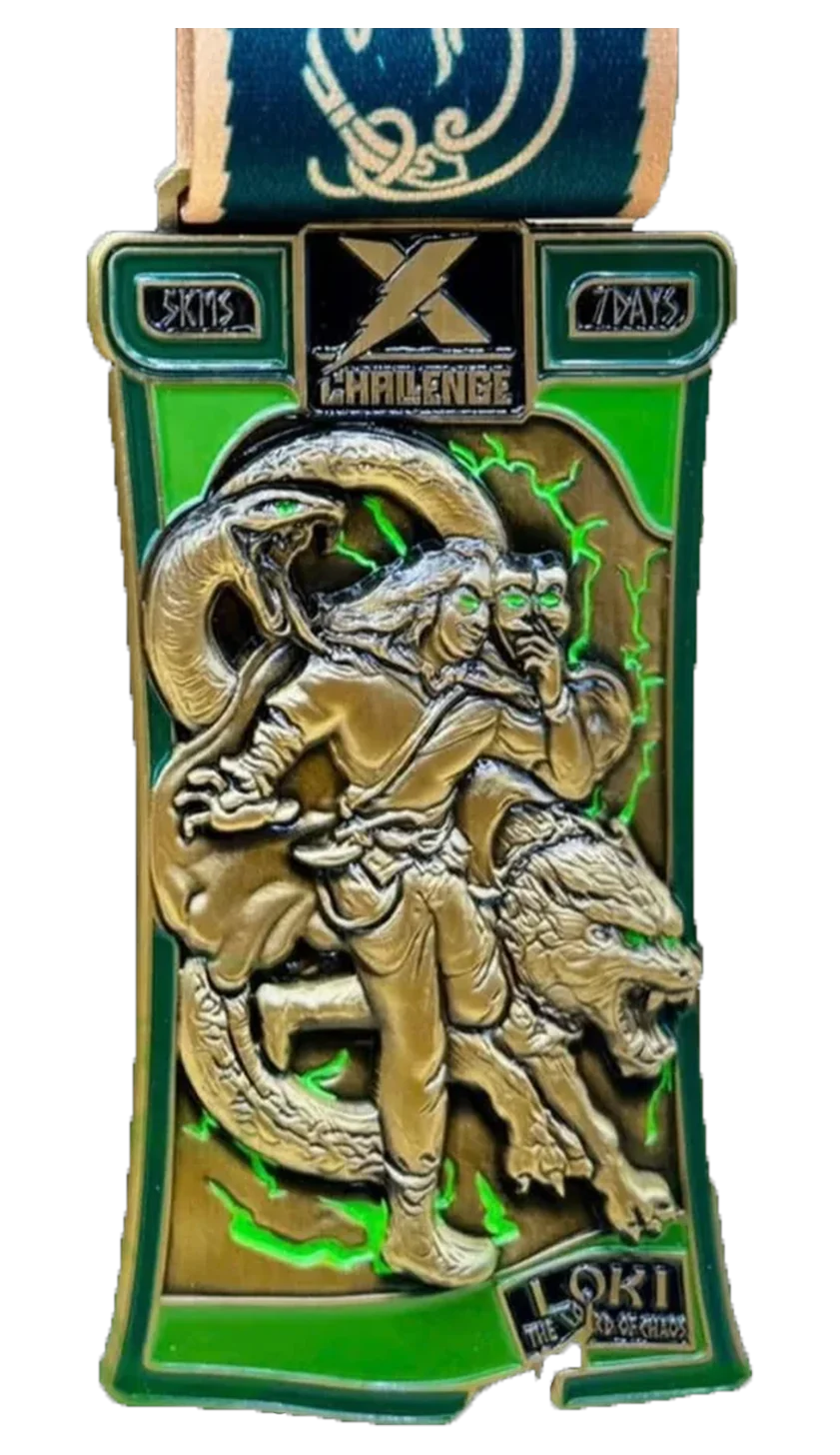
The LOKI medal picks up the same world from the other end. Its reverse shows Bifröst broken open at Ragnarök, its colours spilling through cracked stone, and the bottom edge of the medal is left torn. Hang the two side by side and you have the tree that holds the worlds and the bridge that fails at the end of them.
Common questions
- What kind of tree is Yggdrasil? An ash, in Völuspá and the Prose Edda.
- What are the nine realms? The worlds held in the tree, including Asgard, Midgard and Jotunheim. The sources never list all nine together.
- Is Midgard Earth? Yes. It is the middle world where people live.
- Does Yggdrasil survive Ragnarök? In Völuspá it shakes but is not destroyed, and two people survive in a wood often identified with it.
Sources
- The Poetic Edda, translated by Henry Adams Bellows (1923), Project Gutenberg: Völuspá (the ash, Urd’s well and the Norns, the nine worlds, the tree shaking at Ragnarök, the green earth rising), Hávamál (nine nights on the windy tree), Vafthrúdnismál (Líf and Lífþrasir), and the translator’s notes on the nine worlds and the name Yggdrasil.
- The Younger Edda (Prose Edda) by Snorri Sturluson, translated by Rasmus B. Anderson, Project Gutenberg: the three roots and their wells, Odin’s eye, the creatures in the tree, and Bifröst.
Challenges from this guide
Or take the whole set
More: all guides · how it works · every challenge