
How to set a running goal you will actually reach
Updated · 6 min read

In short: A good running goal is specific, has a date, and fits your life right now. SMART (specific, measurable, achievable, relevant, time-bound) is a handy checklist, but researchers have questioned how well it suits exercise, so pair your main goal with process goals you control, like three runs a week. Set one main goal 4 to 12 weeks out, break it into weekly targets, track them, and decide in advance what you will do on a bad week.
Three kinds of running goal
Most people set only one kind of goal: a result. That leaves nothing to aim at on an ordinary Tuesday. The goals that stick usually stack more than one kind, with a big goal for direction and process goals doing the daily work. The table shows the difference.
| Type | Example | How much you control it | Good for |
|---|---|---|---|
| Outcome | Place in the top half of my age group | Little, since it depends on others | Experienced racers |
| Performance | Run a 5K in under 35 minutes by June | Some | Runners with a base |
| Completion | Finish a half marathon distance this spring | A lot | Most runners |
| Process | Run three times a week at 7 a.m. | Almost all | Everyone, especially beginners |
If you are new, make your main goal a completion goal and back it with one or two process goals. You control both, so a bad race day or a hot week cannot take them away from you.
Using SMART, and framing it right
- Specific: “cover 21 km” beats “run more.”
- Measurable: distance, sessions or minutes you can count.
- Achievable: a stretch, not a leap. Look at what you did in the last month.
- Relevant: tied to why you run, whether that is health, headspace or a medal on the wall.
- Time-bound: a finish date you can write on the calendar.
SMART is useful as a checklist. It is worth knowing its limits, though. A 2023 review in Health Psychology Review argued that SMART goals are widely used for physical activity but lack a clear scientific basis, are applied inconsistently, and may even do harm. Our takeaway: keep the goal specific and dated, but leave room to adjust it. If you are a complete beginner, an open first goal such as “see how far I can walk-run this month” is a fine place to start.
How you word the goal matters. In a year-long study of New Year’s resolutions published in PLOS ONE in 2020, 58.9% of people with approach goals, things to start or do, said they had kept them, against 47.1% of people with avoidance goals, things to stop or cut out. For runners that means “run three times a week” rather than “stop skipping runs,” and “finish a 10K in March” rather than “stop being unfit.”
Pick the right size for you
| Where you are now | A good next goal | Typical time frame |
|---|---|---|
| Not running yet | Walk-run 20 minutes three times a week | 4 weeks |
| Walk-running | Cover 5 km in 7 days | 1 to 2 weeks |
| Running 20 to 30 minutes | Cover 10 km in 10 days, then run 5K without stopping | 4 to 8 weeks |
| Running 5K comfortably | Cover 21 km in 20 days, or a 10K run | 6 to 10 weeks |
| Running 10K | A half marathon distance in one run | 10 to 12 weeks |
| Prefer walking | TURTLE: 68 km in 39 days | About 6 weeks |
A worked example, with checkpoints
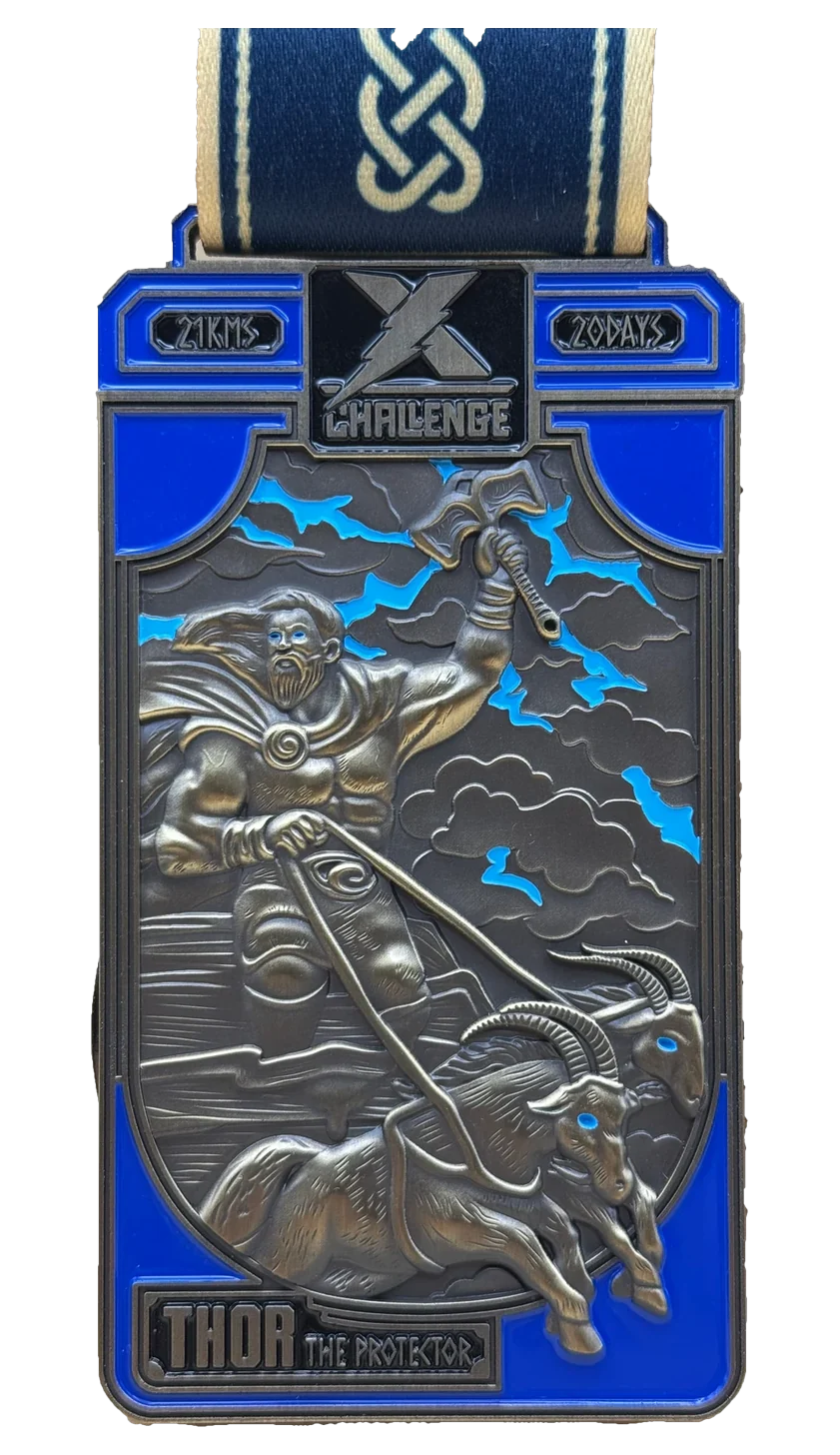
Say your goal is THOR: 21 km (about 13 miles) in 20 days. That averages 1.1 km a day, or about 7.4 km a week. Three sessions a week of about 2.5 km each would cover it, with room for a missed day.
- Main goal: finish the distance inside the window.
- Process goal: three sessions a week, Tuesday, Thursday and Saturday.
- Weekly check: on Sunday, compare your total with the weekly average.
- Bad-week plan: if I miss Tuesday, I run Wednesday. If I miss two, I walk on Sunday.
- Reward: the medal, and a new pair of socks when the app shows the finish.
Write all five lines on one card or in one note on your phone. When a week goes wrong, you do not need to rethink anything. You just follow the plan you made when you were fresh.
A distance challenge with a window, such as ODIN at 10 km in 10 days, already has the S, M and T built in. What you add is the process. Decide how many sessions a week you will do and on which days, and work out a halfway checkpoint. For ODIN, that is about 5 km by day 5. If you hit the checkpoint, carry on. If you are behind, add one short session rather than one long one.
For the long windows, monthly checkpoints work better. KYLIN at 88 km over 68 days is about 39 km a month. Set a reminder for each month’s end and look at your total then, not every day.
When to change your goal
- You are hurt or ill. Pause, recover, and reset the date. Running through pain to hit a target is how small problems become long ones.
- Life changed. A new job or a new baby is a good reason to shrink the goal, not to drop running altogether.
- It is too easy. If you are ahead after two weeks, raise the next goal, not this one.
- You dread it. If the goal makes you want to skip runs, it is the wrong goal. Swap to one you like.
Track it where you can see it
A 2016 review of 138 experiments in Psychological Bulletin found that monitoring progress helped people reach their goals, more so when progress was physically recorded or shared. Write your weekly total on a calendar, or let an app log it, and look at it every Sunday. See tracking your running progress.
Common goal-setting mistakes
- Setting three big goals at once. Pick one main goal per season.
- Choosing a pace goal as a beginner. Times swing with heat and hills, and early progress is mostly about consistency.
- Copying someone else’s goal. A friend’s marathon is not your 5K.
- No plan for bad weeks. Decide now what you will do when you miss a session.
- Moving straight to the next goal without a pause. Take an easy week first.
Common questions
- How far ahead should my goal be? Four to twelve weeks is a good range. Long enough to make progress, short enough to stay real. For a bigger dream, set a series of these, each one a step toward it.
- What if I am falling behind? Adjust the goal or extend the time frame. Changing a goal is not failing.
- Is a pace goal ever a good idea? Yes, once you have run regularly for a few months. Test on the same route and in similar weather so the numbers are fair.
- Should I tell people about my goal? Sharing progress tends to help. Choose people who will encourage you.
- What comes after I finish? Take a week easy, then set the next goal a step up. See collecting medals as motivation.
Sources
- Swann and colleagues, The (over)use of SMART goals for physical activity promotion, Health Psychology Review, 2023
- Oscarsson and colleagues, A large-scale experiment on New Year’s resolutions, PLOS ONE, 2020
- Harkin and colleagues, Does Monitoring Goal Progress Promote Goal Attainment? Psychological Bulletin, 2016
Challenges from this guide


Or take the whole set

More: all guides · how it works · every challenge