
Tracking your running progress: what to watch
Updated · 6 min read

In short: For a new runner, the clearest progress is usually consistency rather than speed: runs per week, total distance per week, and how long you can run without a walk break. A simple check is to compare this week with four weeks ago and notice how it feels. If the same distance feels easier, you are getting fitter, even if your pace has not changed. Write it down every time. Studies of goal tracking find that recording progress helps people reach their goals.
Why tracking helps
A large review in Psychological Bulletin in 2016 pooled 138 experiments in which some people were prompted to monitor their progress toward a goal and others were not. Monitoring helped people reach their goals, and the effect was larger when progress was physically recorded or shared with others. Most of those studies were about health goals such as weight and exercise.
For runners the lesson is simple. Write it down, or let an app do it, and look at it once a week. A log also protects you from the feeling that you are not getting anywhere, because it shows you exactly where you were a month ago. And it catches problems early: a run of high effort scores or a recurring ache is easy to miss day to day and obvious on a page.
Five things worth tracking
| Measure | What it tells you | What progress looks like |
|---|---|---|
| Runs per week | Consistency | Three runs a week, week after week |
| Weekly distance | Volume | Rising slowly, with an easier week every month or so |
| Continuous running time | Endurance | From one minute to 30 without walking |
| How it feels | Adaptation | The same distance feels easier |
| Easy-run heart rate (optional) | Aerobic fitness | Lower at the same pace on the same route |
A simple weekly log
You do not need a spreadsheet. One line per session and one line per week is enough. Rate how hard each run felt from 1 (very easy) to 10 (all-out). Most of your runs should sit around 3 to 5.
| Day | Session | Distance | Time | Effort (1–10) | Note |
|---|---|---|---|---|---|
| Tuesday | Walk-run, jog 3 / walk 2 | 1.8 mi (2.9 km) | 25 min | 4 | Calves tight at the start |
| Thursday | Walk-run, jog 3 / walk 2 | 1.9 mi (3.1 km) | 25 min | 4 | Felt easier than last week |
| Saturday | Longer easy walk-run | 2.5 mi (4 km) | 38 min | 5 | New park loop |
| Week total | 3 sessions | 6.2 mi (10 km) | 88 min | Three for three |
How fast to build, and what about pace
A common rule of thumb is to raise weekly distance by no more than about 10% at a time. Treat it as a ceiling, not a target. Many new runners do better holding the same week two or three times before adding more, and taking an easier week every month or so. If something starts to hurt and does not ease within a few days, back off and see knee pain from running or shin splints.
Pace swings with heat, hills, wind and sleep. A run on a hot July afternoon can be much slower than the same effort on a cool October morning. So compare like with like: the same route at the same time of day, at the same effort. Or run a short test every six weeks, such as a timed mile on a track. See the running pace calculator to turn times into paces.
Phone, watch and common mistakes
A phone with a running app records distance, time and pace well enough for almost everyone starting out. A GPS watch is lighter to carry and easier to glance at, and adds heart rate. It is a nice upgrade once running is a habit, not a requirement to start. See GPS running watches by budget if you are thinking about one.
Whatever you use, check that GPS has locked on before you start, and expect small differences between devices. Tall buildings, tree cover and tight loops make GPS jumpy. On a treadmill, the machine and your phone may disagree too. Pick one device and stick with it so your numbers stay comparable.
- Checking every run against your best run. Compare weeks and months, not single days.
- Only logging the good runs. The short, slow, rainy ones are the ones that build the habit.
- Chasing a weekly total so hard that you skip rest days. The log is there to help you, not to grade you.
- Tracking too much. Five numbers you look at beat twenty you ignore.
- Forgetting to note how you feel. Effort and mood often warn you about tiredness before the numbers do.
Reading your log after a month
Once a month, put your latest week next to the week four weeks earlier. You are looking for trends, not single runs. Here is what common patterns usually mean and what to do about them.
| What you see | What it usually means | What to do |
|---|---|---|
| Same distance, lower effort score | You are getting fitter | Add a few minutes to one run a week |
| Effort rising at the same distance | Tired, stressed or short on sleep | Hold steady or take an easier week |
| Runs per week dropping | The habit is slipping | Shrink the sessions and keep the days |
| Long gaps after hard weeks | Building too fast | Smaller steps, with a rest day after the longest run |
| Notes about the same ache | An early warning | Rest, and see a doctor if it does not settle |
Progress beyond the watch, and milestones
- You climb the stairs at work without stopping to breathe.
- You sleep better on running days.
- You stopped negotiating with yourself before each run.
- You can talk in full sentences on a pace that used to leave you gasping.
- You recover from a hard week in two days instead of four.
Add a line for these in your log. On weeks when the numbers stall, they are often the progress that keeps you going.
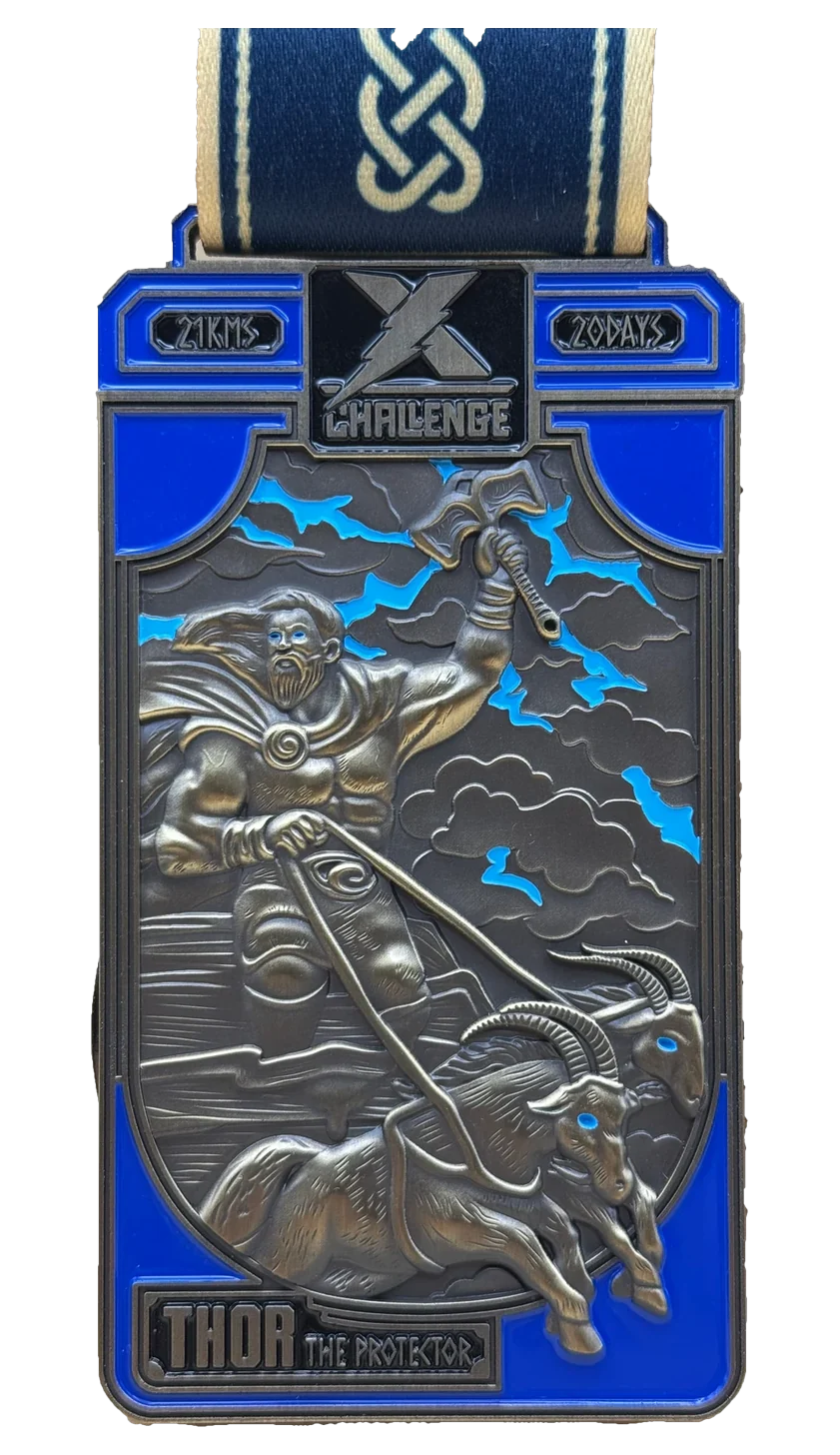
The X Challenge app logs every session, your distance and your challenge progress. LOKI, then ODIN, then THOR make three clear milestones of 5 km, 10 km and 21 km, each with a medal to show for it. Other good milestones: your first 30 minutes without walking, your first month without a missed week, and your first 100 miles in total.
Once those are done, the long challenges turn your log into a bigger story. TURTLE is 68 km (about 42.3 miles) over 39 days, roughly 1.7 km a day. Watching that total climb week by week is tracking at its most satisfying.
Common questions
- How often should I check my progress? Once a week is plenty. Daily numbers bounce around too much to mean anything.
- Do walks count in my log? Yes. Log them like runs. They are part of your weekly activity and count toward a challenge.
- Why is my pace getting slower? Heat, hills, poor sleep and tired legs all slow you down. Compare the same route at the same effort.
- How long before I see progress? Many new runners notice that runs feel easier within a few weeks of regular sessions. Compare with your log, not your memory.
- Should I share my progress? If it helps. The 2016 review found sharing made monitoring work better for many people.
Sources
Challenges from this guide


Or take the whole set

More: all guides · how it works · every challenge