
Carb loading for a half marathon: do you need it?
Updated · 6 min read

In short: Carb loading means eating more carbohydrate than usual for one to two days before a long race so your muscles start full of fuel. The sports nutrition position paper reserves a full load, 10 to 12 grams per kilogram a day for 36 to 48 hours, for events over 90 minutes. So a half marathon in under 90 minutes only needs normal, carb-rich meals. If you will take longer, a simple two-day load can help. Choose low-fiber foods and practice before a long run first.
What carb loading does
Your muscles store carbohydrate as glycogen. On a long, steady effort you burn through it, and when it runs low the pace gets hard to hold. Carb loading fills those stores to the top before the start. Trained runners can do this by eating more carbohydrate and easing off training over about two days.
Do you need it for a half marathon?
| Expected finish | What the position paper suggests | In practice |
|---|---|---|
| Under 90 minutes | 7–12 g/kg a day, as for daily fuel needs | Carb-rich meals the day before; no special load |
| 90 minutes to 2:30 | 10–12 g/kg a day for 36–48 hours | A two-day load helps, if you have practiced it |
| Over 2:30, or walking it | 10–12 g/kg a day for 36–48 hours | A load helps, plus fuel during the race |
Most recreational runners finish a half marathon in more than 90 minutes, so most of them are in the group that can benefit. A full load is a lot of food, though. If it upsets your stomach, a smaller increase on the day before is still useful.
How many grams, worked out
| Body weight | 7 g/kg | 10 g/kg | 12 g/kg |
|---|---|---|---|
| 120 lb (54 kg) | About 380 g | About 545 g | About 655 g |
| 150 lb (68 kg) | About 475 g | About 680 g | About 815 g |
| 180 lb (82 kg) | About 570 g | About 815 g | About 980 g |
That is far more carbohydrate than most people eat on a normal day. You get there by making carbohydrate most of each plate, adding carb-rich snacks and drinks, and cutting back on fat and fiber so you are not overfull.
A two-day sample menu
For a 150-pound runner aiming at about 10 g/kg. Grams are rough; check labels for your own foods.
- Breakfast: a large bagel with jam, a banana, a 12-ounce glass of orange juice (about 140 g).
- Snack: a cup of low-fat fruit yogurt and a granola bar (about 70 g).
- Lunch: a large turkey sandwich on white bread, pretzels, a sports drink (about 150 g).
- Snack: rice cakes with honey, a handful of raisins (about 80 g).
- Dinner: two cups of pasta with tomato sauce and chicken, bread, a glass of juice (about 170 g).
- Evening: a bowl of low-fiber cereal with milk (about 60 g).
That adds up to roughly 670 grams. Repeat a similar day the day before, then eat a familiar breakfast on race morning: the position paper suggests 1 to 4 g/kg in the 1 to 4 hours before a long event.
Foods that make it easier
- White rice, pasta, bagels, white bread, pancakes and low-fiber cereal.
- Potatoes without the skin, and pretzels for salt.
- Juice, sports drinks and chocolate milk, which add carbs without bulk.
- Honey, jam, maple syrup and dried fruit in small amounts.
- Less of: big salads, beans, bran, whole nuts, fried and creamy foods.
Common mistakes
| Mistake | Instead |
|---|---|
| One giant pasta dinner the night before | Spread extra carbs over two days and several meals |
| Adding carbs on top of the usual fat and protein | Swap: more rice and bread, less butter and cheese |
| High-fiber whole grains and salads | Choose white and low-fiber versions for these two days |
| Panicking about the scale | A pound or two of water weight is normal; it is stored with glycogen |
| First-ever load before race day | Try it before your longest training run |
Carb loading and X Challenge
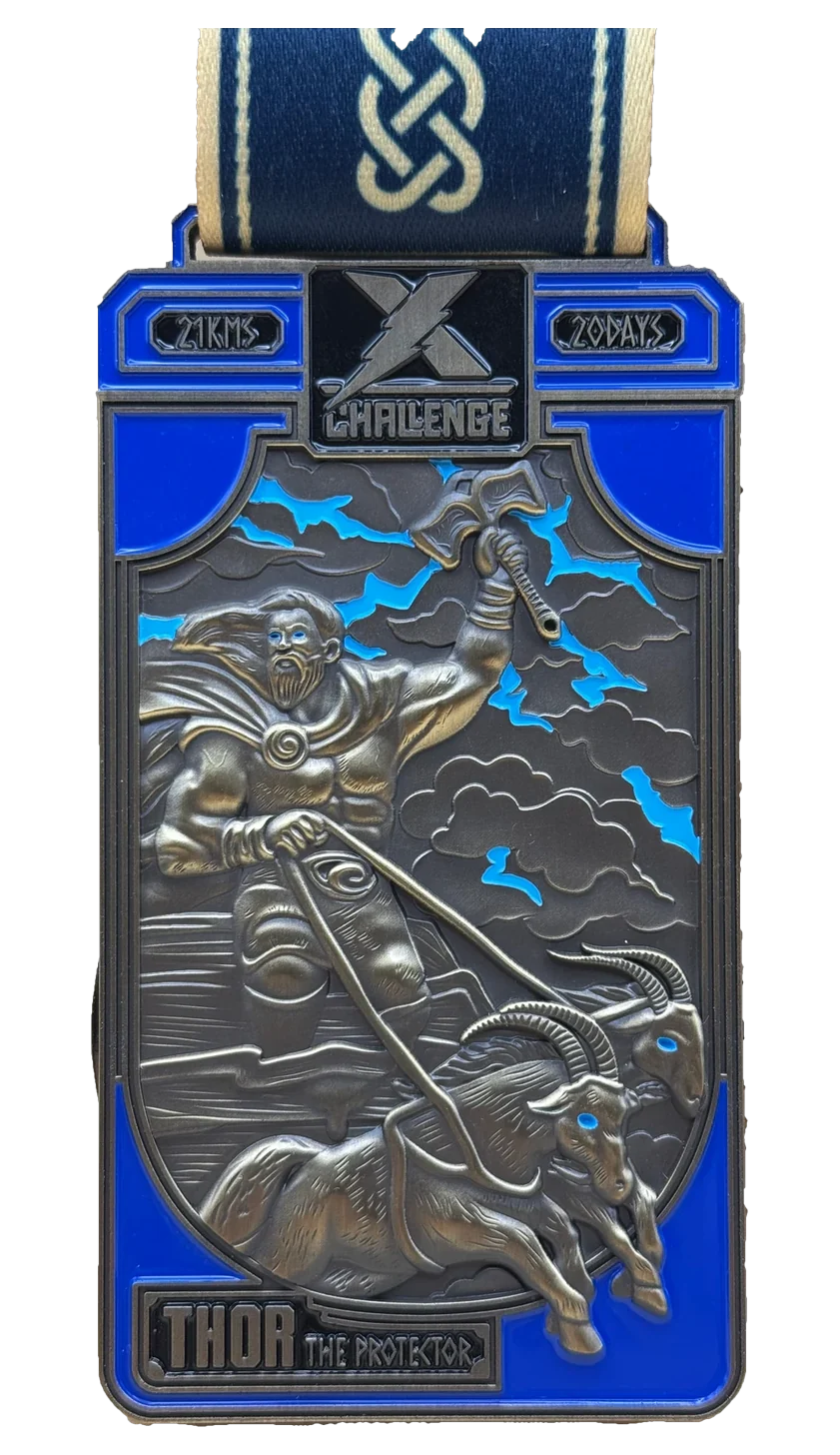
THOR is a half marathon you can spread over 20 days, and most people do. Short daily runs need no carb loading at all. If you choose to run the full 13 miles (21 km) in one go, treat it like a race: load over two days, eat a familiar breakfast, and fuel during the run. See energy gels for running and the virtual half marathon guide.
A week-out timeline
| When | What to do |
|---|---|
| 5–7 days before | Normal eating; plan your loading menu and buy the food |
| 3 days before | Normal eating; cut back on training |
| 2 days before | Start the load: carbs at every meal and snack, less fat and fiber |
| Day before | Keep loading; eat dinner early; drink to thirst |
| Race morning | A tested breakfast 2–4 hours before; a few sips of water |
| During the race | If over 90 minutes, gels or a sports drink from about 40 minutes |
Race morning
Carb loading fills your muscles. Breakfast tops up your liver, which empties overnight. The position paper suggests that carbohydrate eaten 1 to 4 hours before exercise can continue to raise these stores. For a 150-pound runner, a bagel with honey, a banana and a glass of juice three hours before is a reasonable choice. Avoid high-fat, high-protein or high-fiber breakfasts, and eat the same thing you tested before your long runs.
Smaller loads and sensitive stomachs
A full load does not suit everyone. Some runners feel heavy and bloated on 10 g/kg. If that is you, aim for the lower end, around 7 g/kg, from more frequent, smaller meals, and rely more on fuel during the race. Liquid carbohydrate, like juice and sports drinks, adds a lot without filling you up. Whatever you choose, try it before a long training run first, never for the first time before the race.
Smaller runners need fewer total grams, because the targets are per kilogram. A 120-pound runner aiming at 10 g/kg needs about 545 grams a day, far less than the 815 grams a 180-pound runner would.
Walking a half marathon
Walkers still benefit from a tested breakfast and steady snacks. Pick foods that are easy to carry, like a sandwich, a banana and a bag of pretzels.
A half marathon walk takes many people four hours or more. Walking uses fuel more slowly than running, so a full load is less important. Eat a good carb-rich dinner and breakfast, and plan regular snacks during the walk. See walk a virtual half marathon.
Common questions
- How do I know if the load worked? You feel strong in the first half, and you may weigh a pound or two more on race morning. That is water stored with glycogen.
- Do I need to deplete first? Older plans had a low-carb phase first. The position paper notes trained athletes can load without it.
- Should I carb load for a 10K? No. Normal meals are enough for runs under 90 minutes.
- Can I carb load on a low-carb diet? Sudden big changes can upset your stomach. Practice well ahead.
- Should I stop training while loading? Ease off. Short, easy runs are fine.
This is general information for healthy adults. If you have diabetes, heart or kidney disease, are pregnant, or follow a diet set by a doctor, ask your doctor or a registered dietitian first.
Sources
- Nutrition and Athletic Performance, joint position of Dietitians of Canada, the Academy of Nutrition and Dietetics and the American College of Sports Medicine (2016): carb loading for events over 90 minutes, daily needs for shorter events, loading over 48 hours, the pre-event meal.
Challenges from this guide
Or take the whole set

More: all guides · how it works · every challenge