
Can you walk a virtual half marathon and get a medal?
Updated · 6 min read

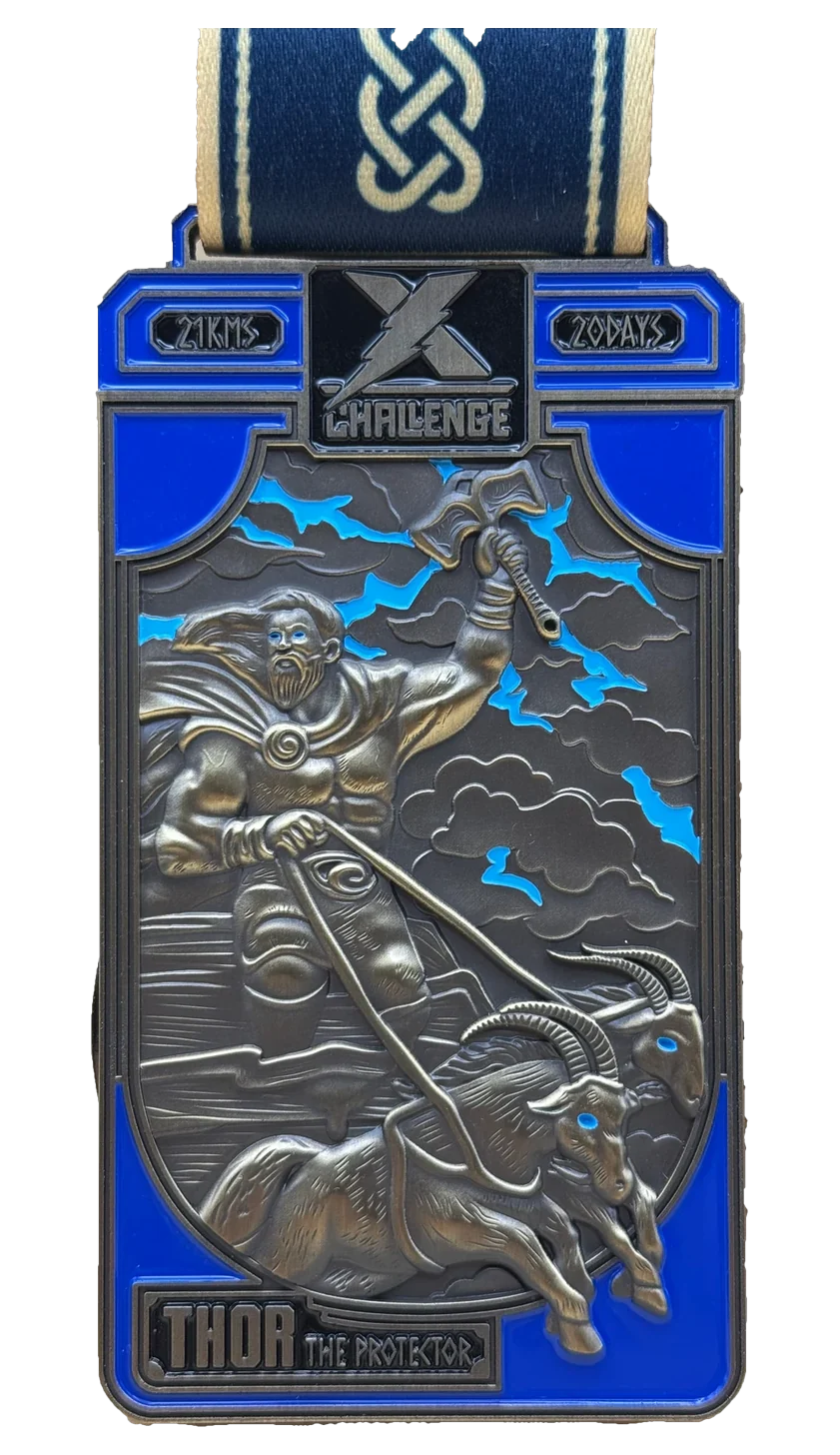
In short: Yes. Many virtual half marathons welcome walkers and mail a real medal when you finish, though some want one continuous effort, so check the rules. A half marathon takes about four to four and a half hours at a steady walk. On X Challenge’s THOR you do not have to do it in one go: 21 km (about 13 miles) in 20 days, about 1.1 km a day on average, with walking counted the same as running. A die-cast THOR medal ships when you finish. $45.
How long it takes on foot
| Walking speed | Time per mile | About 13 miles |
|---|---|---|
| 2.5 mph, easy | 24 minutes | About 5 hours 15 minutes |
| 3 mph, steady | 20 minutes | About 4 hours 20 minutes |
| 3.5 mph, brisk | About 17 minutes | About 3 hours 45 minutes |
| 4 mph, fast | 15 minutes | About 3 hours 15 minutes |
Add time for stops. Water, traffic lights and a bathroom break can add 15 to 30 minutes to a long walk. Most people also slow a little in the last few miles, so plan on the slower end of your range the first time.
One walk or many
Check how the event counts distance. Some want a single effort with a time you submit. Others add up every session. THOR is the second kind, so you choose how to split it.
| Approach | What it looks like | Suits |
|---|---|---|
| A little every day | About 1.1 km, or 15 minutes, a day | Anyone building a habit |
| Three walks | Three walks of about 7 km (4.3 miles) across the window | Busy weeks with free weekends |
| Weekends only | About 3.5 km on each of six weekend days | Weekday commuters |
| One long day | The whole distance in a single walk, after a build-up | Walkers who want the full half-marathon feeling |
An eight-week build-up to one long walk
If you want to walk the full distance in one go, give yourself about two months. This plan assumes you already walk 30 minutes at a time a few days a week without pain. Keep the other walks short and easy.
| Week | Long walk | Roughly how long at 3 mph |
|---|---|---|
| 1 | 4 miles (6.4 km) | 1 hour 20 minutes |
| 2 | 5 miles (8 km) | 1 hour 40 minutes |
| 3 | 6 miles (9.7 km) | 2 hours |
| 4 | 5 miles, an easier week | 1 hour 40 minutes |
| 5 | 7.5 miles (12 km) | 2 hours 30 minutes |
| 6 | 9 miles (14.5 km) | 3 hours |
| 7 | 10.5 miles (17 km) | 3 hours 30 minutes |
| 8 | 5 miles, then the full walk at the weekend | About 4 hours 20 minutes |
Repeat a week if it left you limping or very tired the next day. Only add one thing at a time: distance or speed, not both in the same week. If you have a health condition, are pregnant, or have not exercised in a long time, check with a doctor before you start.
What to bring on a long walk
- Shoes you have already walked at least 20 miles in. Long walks find every rub a new shoe has.
- Synthetic or wool socks, not cotton. Put tape or a blister plaster on known hot spots before you start.
- Water for anything over an hour, more in summer. See how much water to drink for amounts.
- A snack you know agrees with you for walks over two hours, such as a banana, a granola bar or a few chews.
- A charged phone, so the app keeps recording and you can call for a ride if you need one.
- Sunscreen and a cap in summer, gloves and layers in winter.
- A few blister plasters, a small pack of tissues and a card with an emergency contact in your pocket.
Pacing the day
Start slower than feels natural. The first hour should feel easy enough to chat. A steady 3 mph that you hold for four hours beats a fast first hour that leaves you crawling at the end. Take a short break every hour to drink and stretch your calves.
Plan a loop route that passes your home or car every few miles. You can refill water, swap socks or stop without being stuck far away. Split the walk into chunks in your head: four 5 km walks feel smaller than one half marathon.
Looking after your feet and legs
On a long walk, your feet give out before your legs do. Blisters come from heat, moisture and rubbing, and four hours gives them plenty of time. Trim your toenails a couple of days before, not the night before. Make sure your shoes leave about half an inch between your longest toe and the end, since feet swell over a long day.
If you feel a hot spot, stop and deal with it straight away. A plaster or a strip of tape over a hot spot takes a minute. A burst blister at mile 10 can end the walk. Carry a spare pair of socks on anything over three hours and change at the halfway point if your feet are damp.
Keep moving for five to ten minutes at an easy pace before you sit down. Drink, eat a proper meal within a couple of hours, and expect some stiffness in your calves, hips and the soles of your feet the next day. That usually eases in two or three days. A short, easy walk the day after helps more than lying on the couch.
Pain that is sharp, gets worse as you walk, or makes you limp is different from normal soreness. Stop and rest, and see a doctor if it has not improved after a few days. For more, read sore muscles after a run and stretches for after a run, which apply to long walks too.
If you want to run some of it
Mixing is fine. Walk-run sessions and treadmill sessions all add to the same total. If you later want to run the whole distance, read the first-timer’s guide to a virtual half marathon. For other distances on foot, see virtual walking challenges with medals.
Common questions
Is walking a half marathon hard? Spread over a few weeks, it is a gentle goal for most healthy adults. In one day it is a real effort that needs a build-up, mainly for your feet and hips.
What if I fall behind? On THOR, a longer walk at the weekend catches you up. Check your total weekly and you will see a gap early.
Should I use walking poles? Only if you are used to them. They help on hills and trails, but they change your rhythm on flat pavement.
Can I walk it on a treadmill? Yes. Record each session in the app’s indoor mode. Four hours on a belt is a long time, so most people split it into several shorter treadmill walks.
How many steps is a half marathon? Roughly 27,000 to 35,000 for most walkers, depending on stride length.
Sources
- How to Measure Physical Activity Intensity (CDC): walking at 2.5 mph or faster counts as moderate intensity, and during moderate activity you can talk but not sing.
- How to avoid exercise injuries (MedlinePlus, NIH): warm up slowly, cool down for 5 to 10 minutes, do not raise frequency, length and effort all at once, and stop if you feel pain.
- Athletic Shoes (OrthoInfo, American Academy of Orthopaedic Surgeons): what walking and running shoes are built for, how to fit them, and when cushioning wears out.
Challenges from this guide

Or take the whole set

More: all guides · how it works · every challenge