
How many miles is 10,000 steps?
Updated · 6 min read
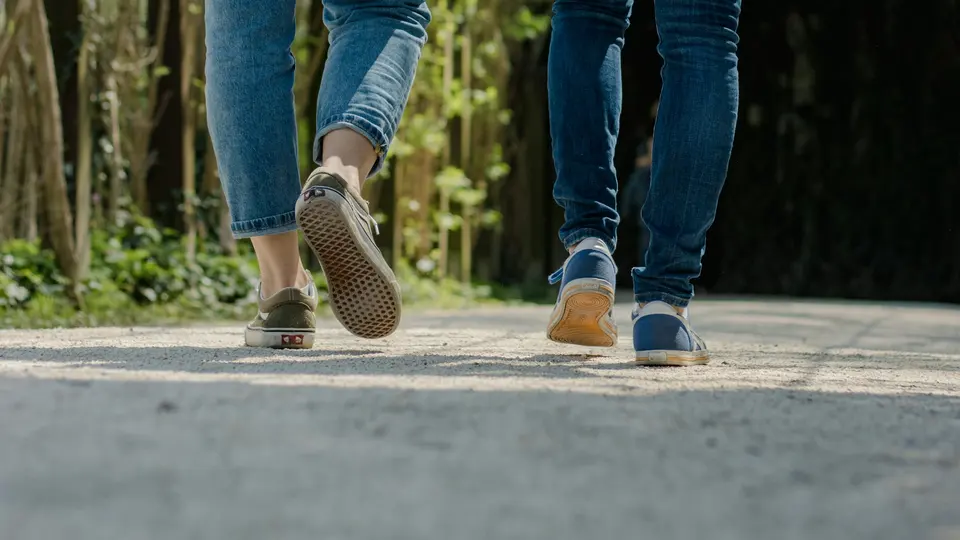
In short: 10,000 steps is about 4 to 5 miles (6 to 7.5 km) for most adults, and takes around 90 minutes to walk. The exact distance depends on your stride, which is usually between 2 and 2.5 feet. You do not have to hit 10,000. The number began with a Japanese pedometer in 1965. A large 2022 analysis found the benefit of more steps leveled off at about 6,000 to 8,000 a day for adults 60 and older, and 8,000 to 10,000 for younger adults.
Steps to miles
| Steps | Miles | Kilometers | Walking time |
|---|---|---|---|
| 2,000 | About 1 | About 1.5 | About 18 minutes |
| 5,000 | About 2.4 | About 3.8 | About 45 minutes |
| 7,000 | About 3.3 | About 5.3 | About 1 hour |
| 10,000 | About 4.7 | About 7.6 | About 1 hour 30 minutes |
| 15,000 | About 7.1 | About 11.4 | About 2 hours 15 minutes |
With a shorter 2-foot step, 10,000 steps is about 3.8 miles (6.1 km). Taller people and fast walkers take longer steps and cover more ground for the same count. Running steps are longer still, so 10,000 running steps can be 6 miles or more.
Work out your own stride
- Find a measured distance: a track lane, a football field (100 yards between goal lines) or a tape measure along a hallway.
- Walk it at your normal pace and count your steps.
- Divide the distance in feet by the number of steps. That is your step length.
- Multiply your daily steps by your step length to get feet, then divide by 5,280 for miles.
Example: you walk 100 yards (300 feet) in 130 steps. Your step is about 2.3 feet. 10,000 steps is then 23,000 feet, or about 4.4 miles. Most phones and watches estimate step length from your height. Entering your height correctly in their settings makes the miles they show more accurate.
Where 10,000 came from and what the research says
The figure did not come from a study. It came from a product name. In 1965 a Japanese company sold a pedometer called the Manpo-kei, which translates as “10,000 steps meter”. A Harvard researcher who traced it calls the name a marketing tool. It stuck because it is round, easy to remember and roughly an hour and a half of walking, which is a decent amount of movement. Researchers have since tested it against real health outcomes, and the answer is more forgiving than the slogan. Fewer steps still help, and the gains come fastest for people who start from the lowest counts.
A 2022 meta-analysis in Lancet Public Health pooled 15 studies of about 47,000 adults who wore step counters. People who took more steps had a lower risk of death over the follow-up period. The benefit kept rising up to about 6,000 to 8,000 steps a day for adults 60 and older, and about 8,000 to 10,000 for younger adults, then leveled off.
An earlier Harvard study of about 16,700 older women found that those averaging about 4,400 steps a day had lower mortality than the least active, who averaged about 2,700. The benefit leveled off around 7,500 steps. These studies show links, not proof that the steps alone caused the difference, but the message is consistent: more is better than less, and you do not need 10,000 to benefit.
How accurate is your step counter?
Phones and watches count steps well on a normal walk, but no counter is perfect. A phone in a bag or a jacket pocket misses some steps. A watch can add steps when you wave your arms while cooking or driving on a bumpy road, and miss them when you push a stroller or a shopping cart.
Distance is a different calculation. Your device turns steps into miles with an estimated step length, so small errors in stride become larger errors in miles. Outdoors, GPS measures distance directly and is usually closer. That is why a distance challenge uses GPS distance rather than a step count. Treat your daily step number as a trend to compare week to week, not an exact figure.
Steps and the 150-minute guideline
The CDC recommends 150 minutes a week of moderate activity, and brisk walking counts. In lab studies of adults, about 100 steps a minute marks moderate intensity. So a brisk 30-minute walk is roughly 3,000 steps. Five of those a week meets the guideline, and the rest of your daily steps come on top.
That gives you two numbers to watch: total steps for general movement, and brisk minutes for fitness. A day of 6,000 slow steps around the house is good. A day with a 30-minute brisk walk inside those 6,000 is better.
How to add 2,000 steps a day
- A 10-minute walk after lunch and another after dinner. That is about 2,000 steps on its own.
- Park at the far end of the lot, or get off the bus one stop early.
- Take phone calls on your feet and walk while you talk.
- Use the stairs for anything up to three floors.
- Walk to a coworker’s desk instead of sending a message.
If you walk about 3,000 steps a day now, adding another 1,000 or 2,000 is a real change. Pick a number you can keep up, and raise it slowly. If you have a health condition, are pregnant, or have not exercised in a long time, check with a doctor before you start.
From steps to a medal
The app counts distance rather than steps, using your phone’s GPS outdoors. Here is roughly what each medal asks of you in daily steps, at about 2.5 feet a step.
| Medal | Average per day | Extra steps a day |
|---|---|---|
| LOKI | 0.7 km | About 900 |
| ODIN | 1 km | About 1,300 |
| THOR | 1.1 km | About 1,400 |
| TURTLE | 1.7 km | About 2,300 |
| KYLIN | 1.3 km | About 1,700 |
| PHOENIX | 1.8 km | About 2,300 |
| DRAGON | 2 km | About 2,700 |
So a short walk most days covers KYLIN over 68 days, and a 30-minute walk does the same for DRAGON. See virtual walking challenges with medals for all seven.
Common questions
How many steps are in a mile? About 2,100 to 2,600 for most adults when walking, fewer when running.
Do treadmill steps count? For your step total, yes. For a distance challenge, record the session in the app’s indoor mode so the distance adds up.
Is 5,000 steps a day enough? It is a good start and well above the least active. Building toward 7,000 or 8,000 is a sensible next goal for most adults.
Will 10,000 steps a day help me lose weight? It helps, mostly by keeping you active, but what you eat matters more. See walking for weight loss for how the two fit together.
Sources
- Daily steps and all-cause mortality: a meta-analysis of 15 international cohorts (Paluch and others, Lancet Public Health, 2022): the benefit of more steps leveled off at about 6,000 to 8,000 a day for adults 60 and older, and about 8,000 to 10,000 for younger adults.
- 10,000 steps a day — or fewer? (Harvard Health Publishing): the 10,000 figure began with a 1965 Japanese pedometer, and in a study of older women about 4,400 steps a day was linked to lower mortality.
- Adult Activity: An Overview (CDC): adults need 150 minutes of moderate activity a week, such as brisk walking, plus muscle-strengthening on two days.
- Walking cadence (steps/min) and intensity in 21–40 year olds: CADENCE-adults (Tudor-Locke and others, 2019): about 100 steps a minute marks moderate intensity, and about 130 marks vigorous.
Challenges from this guide



Or take the whole set


More: all guides · how it works · every challenge