
How long does it take to walk a 5K or a 10K?
Updated · 6 min read
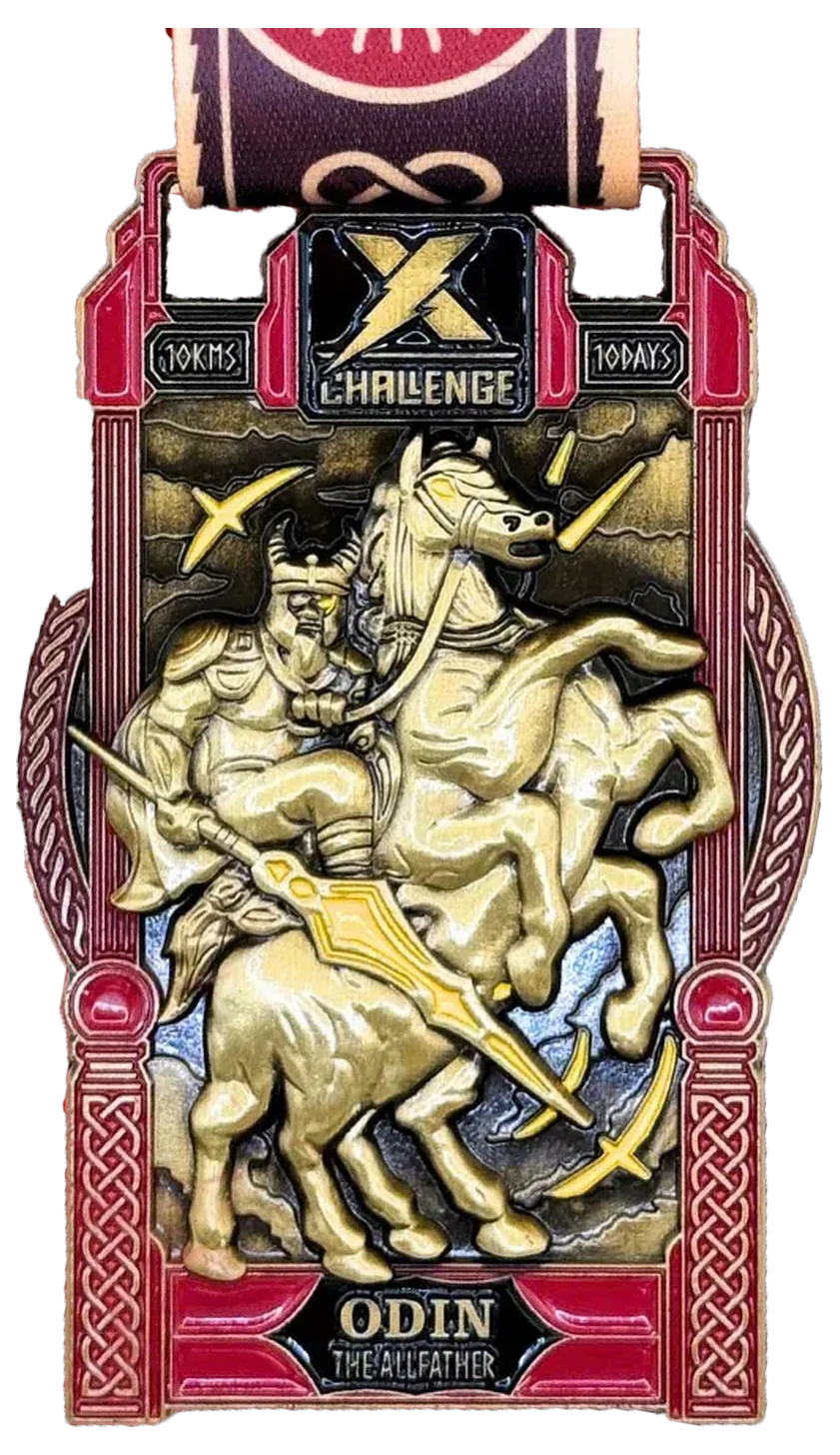
In short: At a typical walking pace of 3 miles an hour, a 5K takes about an hour and a 10K about two hours. A brisk 4 miles an hour brings those down to about 45 minutes and 1 hour 35 minutes. Walking counts in full on X Challenge. LOKI is 5 km in 7 days and ODIN is 10 km in 10 days, in as many walks as you like, with a die-cast medal when you finish. $45 each.
Walking times by speed
| Walking speed | Time per mile | 5K (3.1 miles) | 10K (6.2 miles) |
|---|---|---|---|
| 2 mph, stroll | 30 minutes | About 1 hour 33 minutes | About 3 hours 6 minutes |
| 2.5 mph, easy | 24 minutes | About 1 hour 15 minutes | About 2 hours 30 minutes |
| 3 mph, steady | 20 minutes | About 1 hour 2 minutes | About 2 hours 4 minutes |
| 3.5 mph, brisk | About 17 minutes | About 53 minutes | About 1 hour 47 minutes |
| 4 mph, fast | 15 minutes | About 47 minutes | About 1 hour 33 minutes |
Real walks are a little slower than the table. Crossings, hills and a stop to tie a lace add a few minutes. On a treadmill you can hold the exact speed, so treadmill times come out closer to the table.
How to find your own speed
- Walk a measured mile. A school track is four laps in lane one. Time yourself at a normal effort and you have your pace.
- Record a walk in the app. The GPS gives your distance and your average pace for the whole walk.
- Use the talk test. If you can talk but not sing, you are at a moderate, brisk effort, which for most adults is about 3 to 3.5 mph.
- Count your steps for one minute. Around 100 steps a minute lines up with moderate intensity in lab studies of adults.
Your speed will creep up as you walk more. Re-test every few weeks and update your plans. Use the same route each time so hills and crossings do not skew the result. Once you know your pace per mile, you can plan any walk: multiply it by the miles and add a few minutes for stops.
A four-week plan to walk a 5K, then a 10K
| Week | Three short walks | One longer walk |
|---|---|---|
| 1 | 20 minutes, easy | 30 minutes |
| 2 | 25 minutes, a few brisk minutes in the middle | 45 minutes |
| 3 | 30 minutes, brisk for half of it | A full 5K, about an hour |
| 4 | 30 minutes, brisk | 1 hour 30 minutes, about 4.5 miles |
| 5 or later | 30 minutes, brisk | A full 10K, about 2 hours |
If a week felt hard, repeat it. There is no prize for getting there a week early. If you have a health condition, are pregnant, or have not exercised in a long time, check with a doctor before you start.
Getting ready to walk it
- Wear shoes you have already walked in. New shoes on a long walk are how blisters start.
- Build up. Add five minutes to your longest walk each week until the distance feels easy.
- Warm up with five minutes of easy walking before you speed up, and slow down for the last five.
- Bring water for anything over an hour, especially in the heat.
- Pick a flat loop for your first 10K so you can stop at home if you need to.
- Eat a light meal or snack an hour or two before a long walk, not a big plate right before you leave.
- Charge your phone the night before. A 10K walk with GPS running uses a good share of the battery.
How to walk it faster
Most walkers speed up by taking quicker steps rather than longer ones. Overstriding makes your heel land far in front and acts as a brake. Keep your steps short and turn them over faster.
Bend your elbows to about 90 degrees and swing your arms from the shoulder, front to back. Stand tall, look ahead rather than at your feet, and roll from heel to toe. Add one or two brisk five-minute stretches to an easy walk each week and your normal pace will rise. See brisk walking pace for more.
- Hills. A steady climb can add several minutes a mile. Downhills give some of it back, but not all.
- Heat. In a humid 85°F summer afternoon most people walk slower without noticing. Early mornings are faster and safer.
- Surface. Grass, sand and rough trails are slower than pavement or a treadmill belt.
- Stops. Traffic lights and road crossings add up on a city route. A park loop is quicker.
- Company. Walking with a friend is pleasant but usually slower than walking alone.
Mixing in some jogging
If you want a faster 5K or 10K, short jogs inside a walk are the simplest step up. Walk for four minutes, jog easily for one, and repeat. Over a few weeks, lengthen the jogs. Your time drops quickly, and the walking breaks keep it gentle on your joints.
| Approach | Typical 5K time |
|---|---|
| Steady walk, 3 mph | About 1 hour |
| Brisk walk, 3.5 to 4 mph | 47 to 53 minutes |
| Walk 4 minutes, jog 1 minute | About 45 minutes |
| Walk 2 minutes, jog 3 minutes | About 38 to 42 minutes |
| Easy jog all the way | About 30 to 40 minutes |
If you want to move on to running the whole way, the beginner’s guide to a virtual 5K has a full plan, and how long it takes to run a 5K gives typical running times.
Does a walked 5K count?
At many virtual events, yes, but check for pace limits and whether it must be one session. On X Challenge walking counts the same as running, so LOKI can be a one-hour walk or a 10-minute walk each morning, and ODIN can be two long walks or a short one every day. For longer distances on foot, see virtual walking challenges with medals.
Common questions
Is a 20-minute mile good for walking? Yes. It is 3 mph, a normal steady pace for an adult. A 15-minute mile is fast walking.
How many steps is a 5K? About 6,500 to 8,000 for most adults, depending on your stride. See 10,000 steps in miles to work out your own.
Can I walk a 10K with no training? Many healthy adults can, slowly, but it will likely leave you sore. A few weeks of build-up makes it far more pleasant.
Is a 5K walk good exercise? Yes. An hour of brisk walking counts toward the 150 minutes of moderate activity a week the CDC recommends for adults.
Should I walk a 5K every day? You can, once your body is used to it. Most beginners do better with a rest or short-walk day between longer ones for the first few weeks.
Sources
- How to Measure Physical Activity Intensity (CDC): walking at 2.5 mph or faster counts as moderate intensity, and during moderate activity you can talk but not sing.
- Walking for health (NHS): brisk walking is about 3 mph, and even 10 brisk minutes a day counts.
- Walking cadence (steps/min) and intensity in 21–40 year olds: CADENCE-adults (Tudor-Locke and others, 2019): about 100 steps a minute marks moderate intensity, and about 130 marks vigorous.
- How to avoid exercise injuries (MedlinePlus, NIH): warm up slowly, cool down for 5 to 10 minutes, do not raise frequency, length and effort all at once, and stop if you feel pain.
Challenges from this guide

Or take the whole set

More: all guides · how it works · every challenge