
Virtual walking challenges with medals
Updated · 7 min read

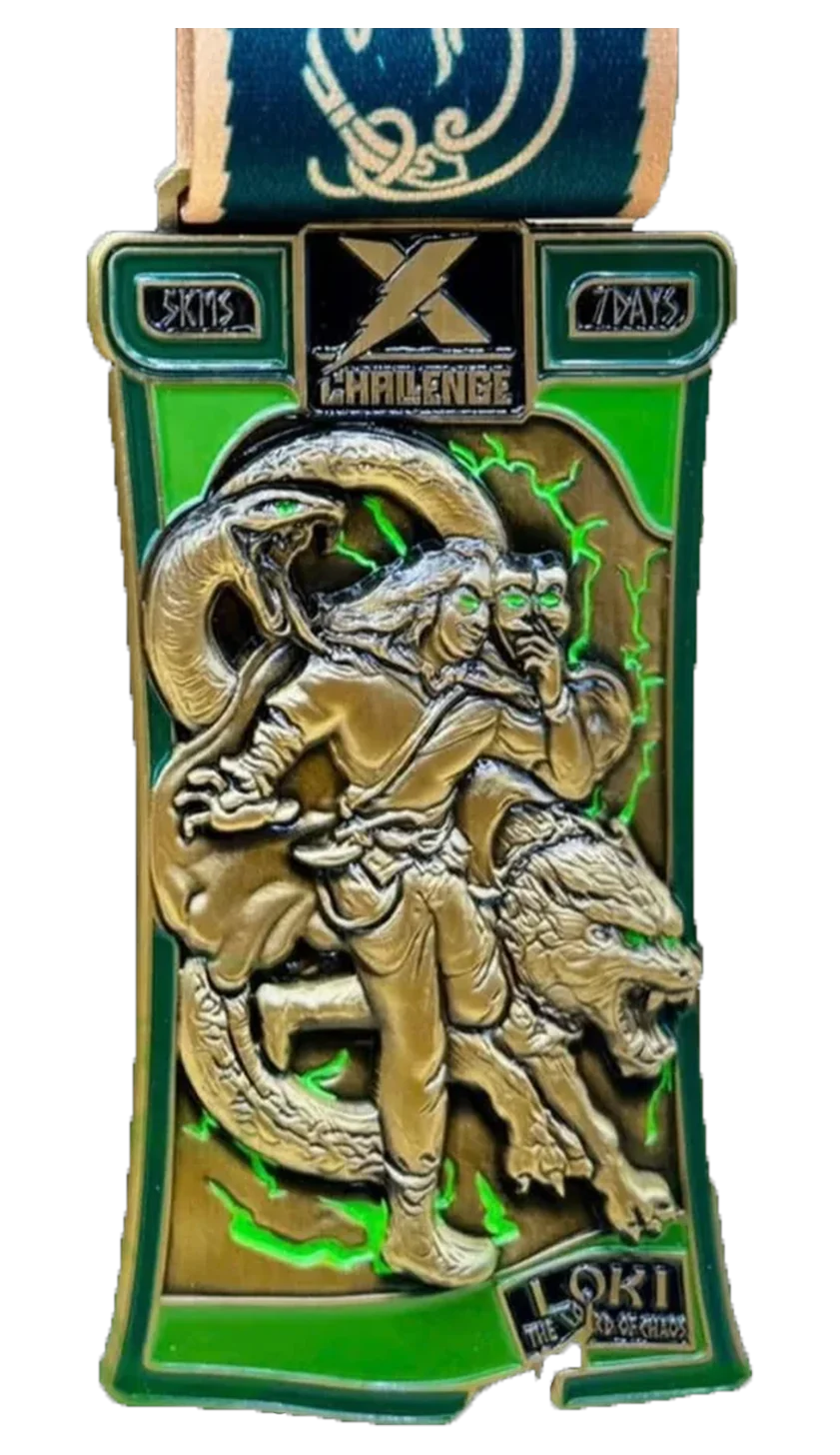
In short: A virtual walking challenge is a set distance you walk on your own routes and schedule, and a real medal is mailed when you finish. On X Challenge, walking counts the same as running on every medal, in as many sessions as you like, with no finish time. The shortest is LOKI: 5 km in 7 days, about 0.7 km a day. For a longer habit, KYLIN is 88 km in 68 days, about 1.3 km a day. Each medal is $45.
What each challenge takes on foot
| Medal | Distance | Time window | Average per day | Daily walk at 3 mph |
|---|---|---|---|---|
| LOKI | 5 km (3.1 miles) | 7 days | 0.7 km | About 10 minutes |
| ODIN | 10 km (6.2 miles) | 10 days | 1 km | About 15 minutes |
| THOR | 21 km (about 13 miles) | 20 days | 1.1 km | About 15 minutes |
| TURTLE | 68 km (42 miles) | 39 days | 1.7 km | About 25 minutes |
| KYLIN | 88 km (55 miles) | 68 days | 1.3 km | About 20 minutes |
| PHOENIX | 139 km (86 miles) | 79 days | 1.8 km | About 25 minutes |
| DRAGON | 179 km (111 miles) | 88 days | 2 km | About 30 minutes |
Those are averages. Nothing requires a walk every day, so a long Sunday walk can cover a quiet week. Three miles an hour is a steady pace for most adults. If you stroll, add a few minutes. If you walk briskly, take a few off. If you have a health condition, are pregnant, or have not exercised in a long time, check with a doctor before you start.
Which medal suits which walker
- Brand new to walking for exercise: LOKI. About 10 minutes a day for 7 days is a gentle first goal, and you finish inside a week.
- You already walk most days: ODIN. 10 km in 10 days fits two or three longer walks with short ones in between.
- You want a big number on the medal: THOR. It is a half marathon on foot, spread over 20 days.
- You want a daily habit that lasts: TURTLE or KYLIN. Both run for weeks at about 20 minutes of walking a day.
- You walk a lot and want the long haul: PHOENIX or DRAGON. They take most of a season and suit dog walkers, commuters on foot and hikers.
How to plan the walks
Start from the daily average, then fit it to your real week. Say you pick KYLIN. That is about 1.3 km a day, or roughly 20 minutes at a steady pace. You could walk it every lunch break. You could also skip two weekdays and walk 40 minutes on Saturday and Sunday. Both get you there.
Build a small buffer early. Weather, travel and colds happen, and they tend to happen in the last week. If you walk a little more than the average in the first half, a lost weekend later costs you nothing. Check your total once a week rather than every day. A week is long enough to smooth out busy days and short enough to catch a slide.
If you are starting from very little, the CDC’s target of 150 minutes a week of moderate activity is a useful ceiling to grow toward. Any of the shorter medals sits well under it, so you can start below that and build up.
A challenge that runs for weeks will meet bad weather. Plan an indoor fallback before you need one. In a Midwest or Northeast winter, a treadmill at the gym, an indoor track or a lap of a big-box store or mall gets you moving when the sidewalks are icy. In a Southern or Southwest summer, walk before 8 a.m. or after sunset, when the heat index is lower, and carry water.
- Loop routes near home are easier to stick with than out-and-back walks far away. You can cut one short without being stranded.
- Parks with paved paths give you good GPS, no traffic, and benches if you need them.
- A walk to the store, to school pickup or to the train counts the same as a walk for its own sake. Record it.
- Wear something bright or reflective after dark. See running in the dark for kit that also works for walkers.
- On very hot days, read running in the heat first. The warning signs are the same on foot.
What to check at any walking challenge
- Whether walking counts in full, or only toward a separate walking category or a lower distance.
- Whether a pace limit applies. Some events flag activities slower than a set speed as invalid.
- How steps become distance. Some count steps from your phone. Others need GPS distance.
- Whether the distance must be one session or can be added up over days.
- Whether the window starts on a set date for everyone or when you press start.
- When the medal ships, where it ships, and what shipping costs.
- Whether you need an outside account, such as a fitness tracker or a social running app, to submit.
How it works on X Challenge
Open the app, tap Start on your challenge, and record each walk. Your phone’s GPS measures it outdoors, and indoor mode covers a treadmill. You do not need a watch, a Strava account or a set route, and there is no finish time to beat. Each walk adds to the same total, and the medal ships when you reach the distance.
New to it? LOKI is a good first week. If you want a medal for a longer walk, see walking a virtual half marathon or how the long challenges break down. For the pace itself, read what counts as a brisk walking pace.
Walking with other people
A walking challenge is easy to share. Each person records their own walks on their own phone, so a couple, a family or a group of coworkers can take on the same medal and walk together whenever it suits. A partner makes it harder to skip a planned walk, and the time passes faster when you are talking.
- Agree on a pace the slowest person can hold while still chatting.
- Dog walks count. A daily dog walk often covers the shorter medals with no extra time at all.
- Pushing a stroller counts too. Choose smooth paths and keep the pace easy.
- For more ideas, read running with friends. Most of it works the same on foot.
Common mistakes
- Picking the longest medal first. A short one you finish builds more confidence than a long one you abandon.
- Leaving most of the distance for the last week. One bad week of weather and the window is gone.
- Walking in brand-new shoes on day one. Break them in on short walks first.
- Forgetting to press record. Start the app before you leave the door, not halfway round the block.
- Doing too much too soon. Add time slowly, and back off if a joint starts to hurt rather than ache.
Common questions
Can I mix walking and running? Yes. Every session adds to the same total, whether you walked, jogged or did a bit of both.
Do I have to walk outside? No. Treadmill walks count. See the treadmill guide for how indoor sessions are recorded.
Does a slow walk count? Yes. A slow walk counts the same as a fast one, and there is no finish time to beat. What matters is the distance inside the window.
Do I need a watch? No. Your phone’s GPS records outdoor walks, and a watch is optional.
Sources
- Adult Activity: An Overview (CDC): adults need 150 minutes of moderate activity a week, such as brisk walking, plus muscle-strengthening on two days.
- How to Measure Physical Activity Intensity (CDC): walking at 2.5 mph or faster counts as moderate intensity, and during moderate activity you can talk but not sing.
- Walking for health (NHS): brisk walking is about 3 mph, and even 10 brisk minutes a day counts.
Challenges from this guide


Or take the whole set


More: all guides · how it works · every challenge