
Are virtual races worth it?
Updated · 6 min read

In short: A virtual race is worth it if a deadline and a physical medal help you keep moving. It is not worth it if you want a crowd, a start line and an official time. You are mostly paying for a goal and a keepsake, since you could cover the distance for free. Before you buy, check who runs it, what the medal is, when it ships, how distance is checked and what the refund terms are. If any of those is vague, skip it.
The pros and the cons
| Aspect | Pros | Cons |
|---|---|---|
| Experience | Any route, any day, no travel | No crowd, no start line, no finish-line moment |
| Motivation | A deadline and a reason to get out | Easy to put off with nobody expecting you |
| Cost | No travel, parking or race-day costs | You pay for something you could do for free |
| Result | A medal to keep | No official time, and rarely any ranking |
| Pressure | No cutoffs, no corrals, no one watching | No one cheering you through the hard part |
| Who it suits | Beginners, walkers, busy people, collectors | People who want to race others |
What you are actually paying for
Nobody needs permission to walk 5 km. What a virtual race sells is the structure around it: a distance someone else chose, a date that makes you start, a record of finishing, and something physical at the end. If those are the things that get you out the door, the price buys real behavior change. If they are not, it buys a medal.
- A goal with an edge. A fixed distance and a deadline are easier to act on than “run more.”
- Accountability. Money spent and a clock running are small nudges, and small nudges work on busy weeks.
- A keepsake. A good die-cast medal lasts. A cheap one ends up in a drawer.
- Shipping and packaging. Check whether these are in the price or added at checkout.
Who gets the most out of one
- New runners and walkers who want a first finish line without the nerves of a crowd.
- People with shift work, kids or travel who cannot commit to a race on a set Saturday.
- Runners between races who want a reason to keep moving in the off months.
- Collectors who enjoy a themed set and like each medal to stand for a real effort.
- Friends in different cities who want the same goal on their own roads.
When to skip one
- You want the atmosphere. A local road race gives you something a virtual one cannot. Compare them in virtual race vs in-person race.
- You do not care about medals. A free app and a calendar goal may do the same job.
- You want a ranked result or a qualifying time. Virtual events rarely offer either.
- The details are vague. Be wary if you cannot find who runs it, what the medal looks like, or the refund terms.
What a good medal looks like
If the keepsake is a big part of what you are paying for, judge it like any other object you would keep. A good finisher medal is cast metal with real weight, detail on both sides, and a ribbon made for it rather than a generic one. Thin stamped medals with a sticker on the back look fine in a photo and disappointing in the hand.
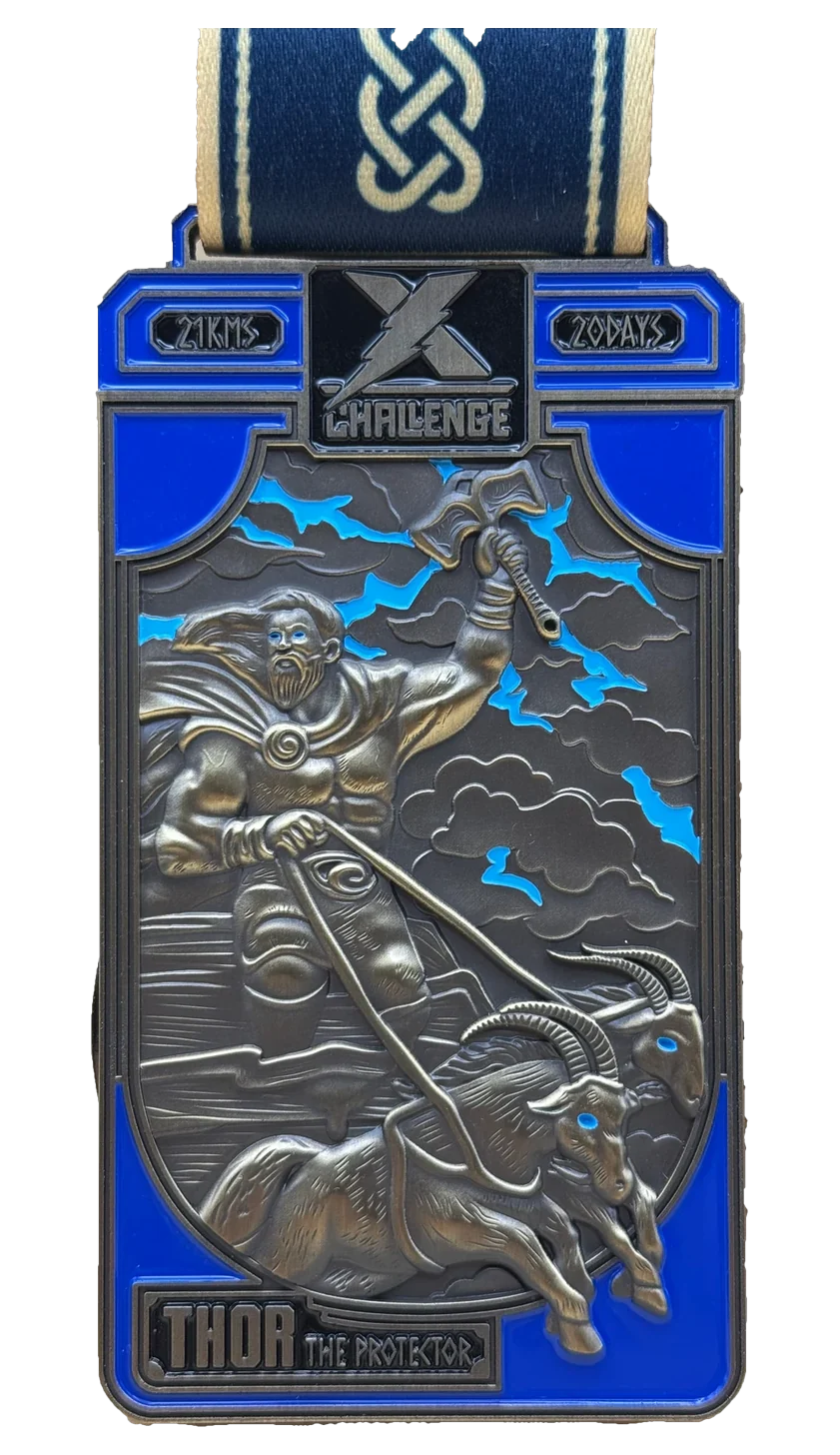
Ask for photos of the real medal, not a render, and look for the size. X Challenge medals are die-cast zinc alloy, 3 to 4 inches across, double-sided, with a 30-inch ribbon and a gift box, and the distance and window are struck into the metal. More in what makes a good finisher medal.
Signs of poor value
- The medal ships before you start and nothing checks that you finished.
- Shipping is only revealed at the last step, or costs more than you expected.
- There is no address, company name or contact email on the site.
- The medal photos are drawings, or the same picture is used for every distance.
- There is no refund policy, or it is hard to find.
What to check before you pay
- Who is behind it: a company name, an address and a way to contact them.
- Reviews on sites the organizer does not control.
- Photos of the actual medal, front and back, not just a drawing.
- Whether the medal ships at sign-up or only after you finish.
- How distance is counted, and whether walking and treadmills count.
- When the clock starts, and what happens if you fall behind.
- The full cost including shipping, and the refund terms.
How X Challenge answers those
X Challenge is run by ELITE GROUP SPORTS AND SERVICES LLC, 1500 N Grant St Ste N, Denver, CO 80203. Medals are die-cast and double-sided, with a ribbon and gift box, and ship 5–10 business days after the app records your finish. Any activity with a recorded distance counts. The window starts when you tap Start, not when you buy. Refunds are in full within 30 days of purchase if you have not started; once started, the sale is final. Shipping is calculated at checkout and goes to the 50 US states. Tracking is in the free X Challenge app, which is on iPhone only for now.
See how it works, who we are and how the formats compare.
Getting your money’s worth
The value of a virtual race comes from how you use it. A few habits make the difference between a medal you earned and an email you forgot about.
- Start soon after you buy, while you still feel the pull. A challenge left for months tends to stay there.
- Put the first three sessions in your calendar before you start the clock.
- Tell a friend, or bring one along. Someone asking how it is going is cheap accountability.
- Pick a medal you actually like the look of. You will think about it on the days you do not want to go out.
- When you finish, decide on the next goal within a week, so the habit does not stop with the medal.
Compared with an in-person race, a virtual one usually costs less in total once you count travel and parking. Compared with doing nothing, the question is only whether it gets you moving. For many people, it does.
A simple test
Think back to the last time you set yourself a fitness goal with no date and nothing at stake. If it faded within a couple of weeks, a deadline and a medal are probably worth paying for. If you already move most days without help, you may not need one, though a themed medal can still be a nice marker for a distance you were going to do anyway.
If you are unsure, start small. Loki is 5 km in 7 days at $45, and it tells you quickly whether the format works for you.
Common questions
- Are virtual races a scam? Most are not, but some are thin on details. Run the checklist above before you pay.
- Do virtual race medals count? They count as a record that you did the distance. They are not an official race result.
- Is walking cheating? No. Most virtual events, including every X Challenge, count walking the same as running.
- What if I do not finish? On X Challenge no medal ships unless the distance is recorded, so write to support before the window ends if life gets in the way.
Challenges from this guide


Or take the whole set

More: all guides · how it works · every challenge