
Virtual race vs in-person race: which is right for you?
Updated · 6 min read

In short: An in-person race gives you a start line, a crowd, aid stations, a closed course and an official time. A virtual race gives you your own route, your own schedule and no travel, but no one cheering and no one handing you water. Choose in-person if atmosphere and a ranked time matter most. Choose virtual if flexibility matters most, or if you want a first goal without the nerves. Many runners do both, using a virtual challenge to build up to a local race.
Side by side
| Aspect | In-person race | Virtual race |
|---|---|---|
| Date and time | Fixed, often an early start | Your choice inside a window |
| Course | Set, measured, often closed to traffic | Anywhere, including a treadmill |
| Atmosphere | Crowds, music, other runners | Quiet, unless you bring friends |
| Water and aid | Aid stations and medical staff | Whatever you carry or plan for |
| Timing | Official chip time and ranking | Your own watch or app, rarely ranked |
| Costs beyond entry | Travel, parking, sometimes a hotel | Usually shipping only |
| Cutoffs | Often a time limit on course | Usually a deadline in days, not minutes |
| Splitting the distance | No, one continuous effort | In cumulative formats, yes |
What an in-person race gives you
The energy of a start corral is hard to recreate. Running with hundreds of people pulls most of us faster than we would go alone, and strangers cheering your name at mile 10 helps more than you would expect. You also get a measured course, an official time and a result you can compare year to year.
The cost is rigidity. The race is on a set morning, whatever the weather or your week. Popular races sell out, and many have a time limit that can worry slower runners and walkers.
What a virtual race gives you
Flexibility. You choose the day, the route and the time, and in a cumulative format you can split the distance into pieces. That makes it workable for people with shift work, small children or travel, and for anyone who finds a crowd stressful.
It also lowers the bar for a first goal. Nobody watches you walk, and nobody sweeps you off the course. For a beginner, that is often the difference between starting and not.
Pacing, water and safety are on you
Without race staff, you plan what a race would plan for you. Run where there are sidewalks and other people. Carry water or loop past home. Tell someone your route if you go far. In summer, the CDC advises training earlier or later in the day when it is cooler, starting slowly and drinking before you feel thirsty. Muscle cramps can be an early sign of heat illness, and if you feel faint or weak, stop and get somewhere cool.
More on this in running in the heat, road safety for runners and running alone safely.
Using one to prepare for the other
A virtual challenge makes a good training block for a local race. Sign up for a spring 10K, then use a cumulative challenge in the weeks before it to make sure you move most days. Going the other way, a runner who enjoyed a race can keep the habit through the off season with a virtual goal.
- Building to a local 5K: Loki in the first week, then keep the same routine.
- Building to a 10K: Odin gets you moving on most days for 10 days.
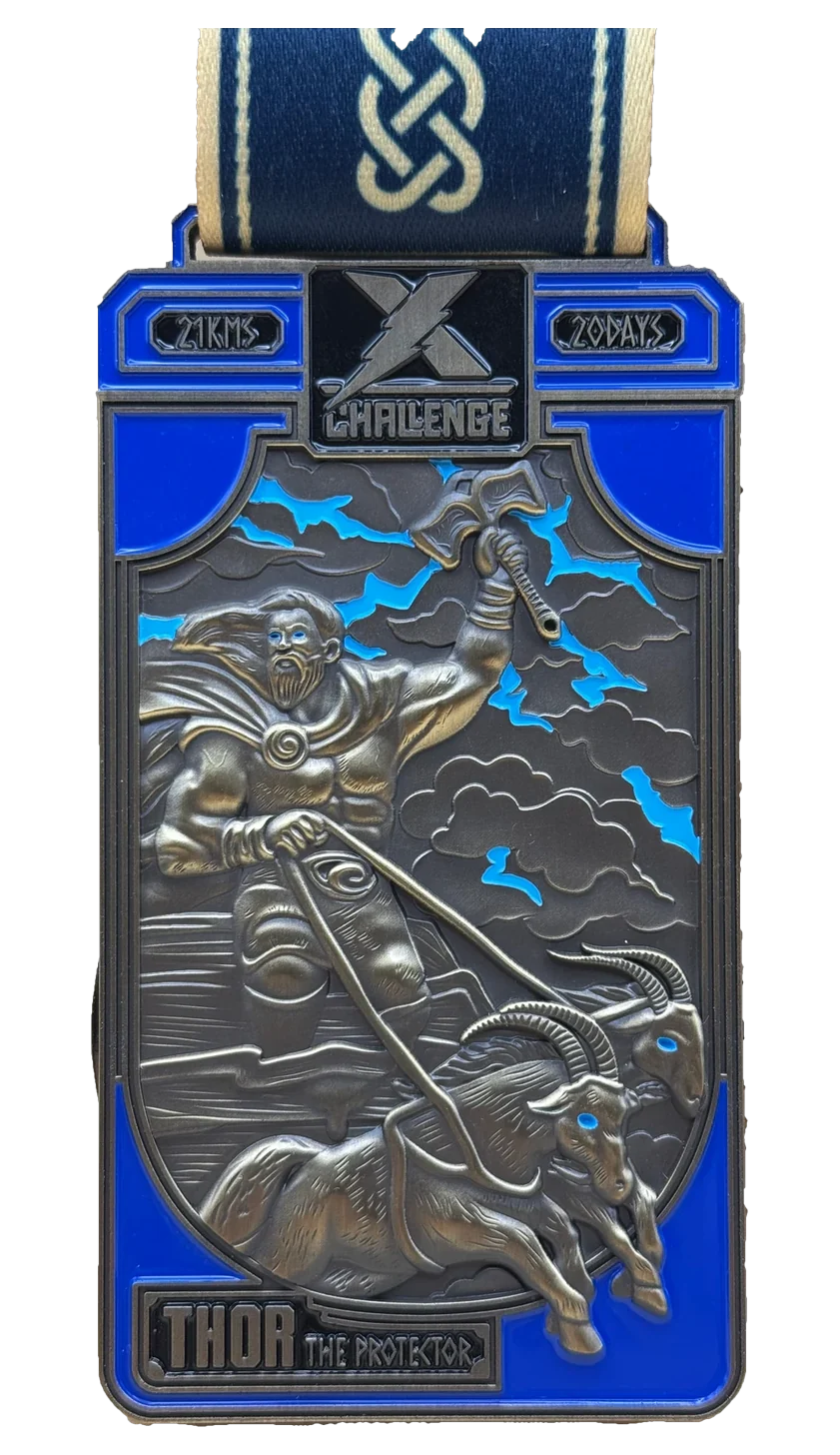
- Building to a half marathon: Thor adds up to the race distance over 20 days, a good base before the longer runs of a plan.
- Keeping going in winter: a long window such as Kylin at 68 days.
The cost picture
Entry fees for local races and virtual events can look similar. The difference is everything around the entry. An in-person race can add travel, parking, a hotel for a destination race, and meals out. A virtual race usually adds shipping and nothing else, because you start from your own door.
What you get also differs. A race entry often includes a shirt, timing, aid stations, road closures and medical cover. A virtual entry mostly buys the goal and the medal. If you value the race-day services, the in-person price is fair. If you mostly want the medal and the reason to train, virtual is better value.
A season that mixes both
- Pick a local race two to three months away, on a date that suits you.
- Use a virtual challenge in the first weeks to build a routine of moving most days.
- In the middle weeks, follow a beginner plan for the race distance, with one longer session a week.
- Run the race, line up near the back, and enjoy it.
- Afterwards, keep the habit going with another virtual goal through the off season.
Making a virtual race feel like race day
- Pick a date and tell people. A set morning with a plan feels different from “sometime this week.”
- Lay out your clothes the night before, and eat what you would eat before a race.
- Choose a route with a clear finish, like your front door or a park gate.
- Bring someone: a friend running with you, or family waiting with a sign at the end.
- Take a finish photo, and save it for when the medal arrives.
Your first in-person race after a virtual one
If a virtual challenge has got you moving and you fancy a real start line, a local 5K is the gentle first step. A few things to know:
- Line up near the back. The front is for fast runners, and starting too fast is the classic first-race mistake.
- Pick up your bib the day before if you can, so race morning is calm.
- Wear nothing new. Shoes, socks and clothes should all be things you have trained in.
- Walking is allowed in most local races. Check the time limit if you plan to walk the whole way.
- Enjoy the aid stations and the crowd. That is what you came for.
Which to choose
- You want a personal best or a ranked result: in-person.
- You love the crowd and the day out: in-person.
- You are a beginner, a walker or nervous about cutoffs: virtual.
- Your schedule changes week to week: virtual.
- Your friends live in different states: virtual, with the same goal for everyone.
- You want a keepsake for a distance you earned on your own terms: virtual, from an organizer that ships after you finish.
Common questions
- Is a virtual race easier? The distance is the same. Splitting it up, where the format allows, makes it more manageable.
- Will my virtual time count for qualifying? Almost never. Qualifying races want an official in-person time.
- Can I do a virtual race on race day with friends? Yes. Many people run a virtual distance together on a local route.
- Is the medal the same? Race medals vary a lot. Look at photos of the actual medal before you choose either.
- Do I need a running watch for either? No. A phone app is enough for a virtual race, and an in-person race times you with a chip on your bib.
- Which is better for a total beginner? Usually virtual first, so the first finish happens without a time limit or a crowd. Then try a local 5K once you feel ready.
Sources
- Heat and Athletes, CDC: train earlier or later in the day when it is cooler, start slowly, and drink before you are thirsty.
Challenges from this guide


Or take the whole set

More: all guides · how it works · every challenge