
Your first virtual 5K: a beginner’s guide
Updated · 6 min read

In short: A virtual 5K is 5 kilometers (3.1 miles) you cover wherever you are, on your own schedule, instead of on a race course. Most beginners get there with walk-run intervals three times a week for about nine weeks, starting with one minute of jogging and a minute and a half of walking. If you would rather not run at all, you do not have to. On the X Challenge Loki challenge you have 7 days to cover 5 km by walking, running or both, in as many sessions as you like.
What counts as a virtual 5K
The distance is the only fixed part. Where you go, when, and how fast are yours to choose: a park loop, the streets around your home, a high school track or a treadmill. What differs between events is how the organizer counts it. Some want one continuous 5 km and a finish time you submit. Others add up everything you log until you reach the total.
On X Challenge it is the second kind. The Loki challenge counts every session the X Challenge app records inside its 7-day window, so 5 km can be one run or five 1 km walks. That makes it a good first goal. You can finish it before you can run the whole distance at once.
Before your first session
- Check your health. If you have a health condition, are pregnant, or have not exercised in a long time, check with a doctor before you start.
- Wear shoes that fit and feel comfortable from the first step. Fit matters more than price for a 5K.
- Pick a flat, safe route of about a mile that you can repeat. A loop near home removes one excuse.
- Decide your three days now. Monday, Wednesday and Saturday works for many people because there is always a rest day in between.
- Plan for about 30 to 40 minutes per session, including a five-minute walk to warm up and another to cool down.
- If you will be out early or late, wear something bright and pick lit streets. See running in the dark and road safety for runners.
A nine-week walk-run plan
Beginner programs such as the NHS Couch to 5K broadly agree on the shape: three sessions a week with rest days between them, a five-minute walk before and after each one, and jogging intervals that get longer as the walking breaks get shorter. This is the outline of that plan.
| Week | Each session (after a 5-minute warm-up walk) | Running in total |
|---|---|---|
| 1 | Jog 1 minute, walk 1½ minutes, eight rounds | 8 minutes |
| 2 | Jog 1½ minutes, walk 2 minutes, six rounds | 9 minutes |
| 3 | Jog 1½, walk 1½, jog 3, walk 3, then repeat once | 9 minutes |
| 4 | Jog 3, walk 1½, jog 5, walk 2½, jog 3, walk 1½, jog 5 | 16 minutes |
| 5 | Three different sessions, ending with a 20-minute jog | 15 to 20 minutes |
| 6 | Three different sessions, ending with a 25-minute jog | 18 to 25 minutes |
| 7 | Jog 25 minutes without stopping | 25 minutes |
| 8 | Jog 28 minutes without stopping | 28 minutes |
| 9 | Jog 30 minutes without stopping | 30 minutes |
Thirty minutes of easy running covers 5 km for some people and 3.5 km for others. Both are fine. If you finish week 9 short of 5 km, add a few minutes of walking or jogging at the end, or keep running three times a week and the distance will come.
Repeat any week that felt hard. The plan says you can repeat a run or a week whenever you are not ready to move on, and taking twelve weeks instead of nine is common.
How fast to jog
Slower than you think. The CDC’s talk test is a good guide: at a moderate effort you can talk but not sing, and at a vigorous effort you cannot say more than a few words without stopping for breath. Most of your jogging should feel like the first one. If you are gasping by the end of a one-minute interval, halve your speed next time.
Running too fast is the most common reason beginners stall. It makes the intervals feel impossible and leaves your legs sore for days. For numbers, see the running pace calculator.
Hills count as harder work, so shorten your stride and slow down on the way up rather than pushing to keep the same speed. On a treadmill, start at a speed where you could keep talking, often 4.5 to 5.5 mph for a beginner, and stay there for the whole interval. If your breathing is fine but your legs ache, the pace is still too quick for your muscles. Slow down anyway.
Using Loki as your first finish line: 5 km in 7 days
5 km over 7 days is about 0.7 km a day, so the challenge fits inside any week of the plan. Three ways people split it:
- Five evening walks of 1 km, about 10 to 12 minutes each.
- Three walk-run sessions of about 1.7 km, with rest days between them.
- One 5 km walk or run at the weekend, if you would rather do it in one go.
Some people start the window in week 1 so the medal is there from the start. Others save it for week 9 and use it as a graduation run. The window starts when you tap Start in the app, not when you buy, so you can pick the week. See the Loki challenge.
Common beginner mistakes
- Skipping the warm-up walk. Five minutes of brisk walking makes the first jog much easier.
- Running on back-to-back days in the first weeks. Rest days are where the progress happens.
- Chasing distance instead of time. The plan is built on minutes, so a slow jog still counts.
- Moving on too soon. If the last interval of a week felt like a struggle, repeat that week.
- Ignoring pain. Normal muscle soreness fades in a day or two. Sharp pain, or pain that gets worse as you run, is a reason to stop. See shin splints and knee pain.
Virtual 5K races with medals: what to check
- When the medal is sent. Some virtual 5K runs mail it at sign-up, others only once you have finished.
- Whether walking counts, if you plan to walk some or all of it.
- How the distance is checked: a time you submit, a screenshot, or an app that records it.
- Whether the distance has to be done in one go or can be added up across sessions.
- What the medal is made of. See what makes a good finisher medal.
Common questions
- Can I walk a virtual 5K? Yes, on any event that says walking counts. At a steady walk it takes about an hour. See how long it takes to walk a 5K.
- How long until I can run 5K without stopping? About nine weeks on a walk-run plan, often longer, and that is normal.
- Do I need a running watch? No. A phone app that records GPS distance is enough for a 5K.
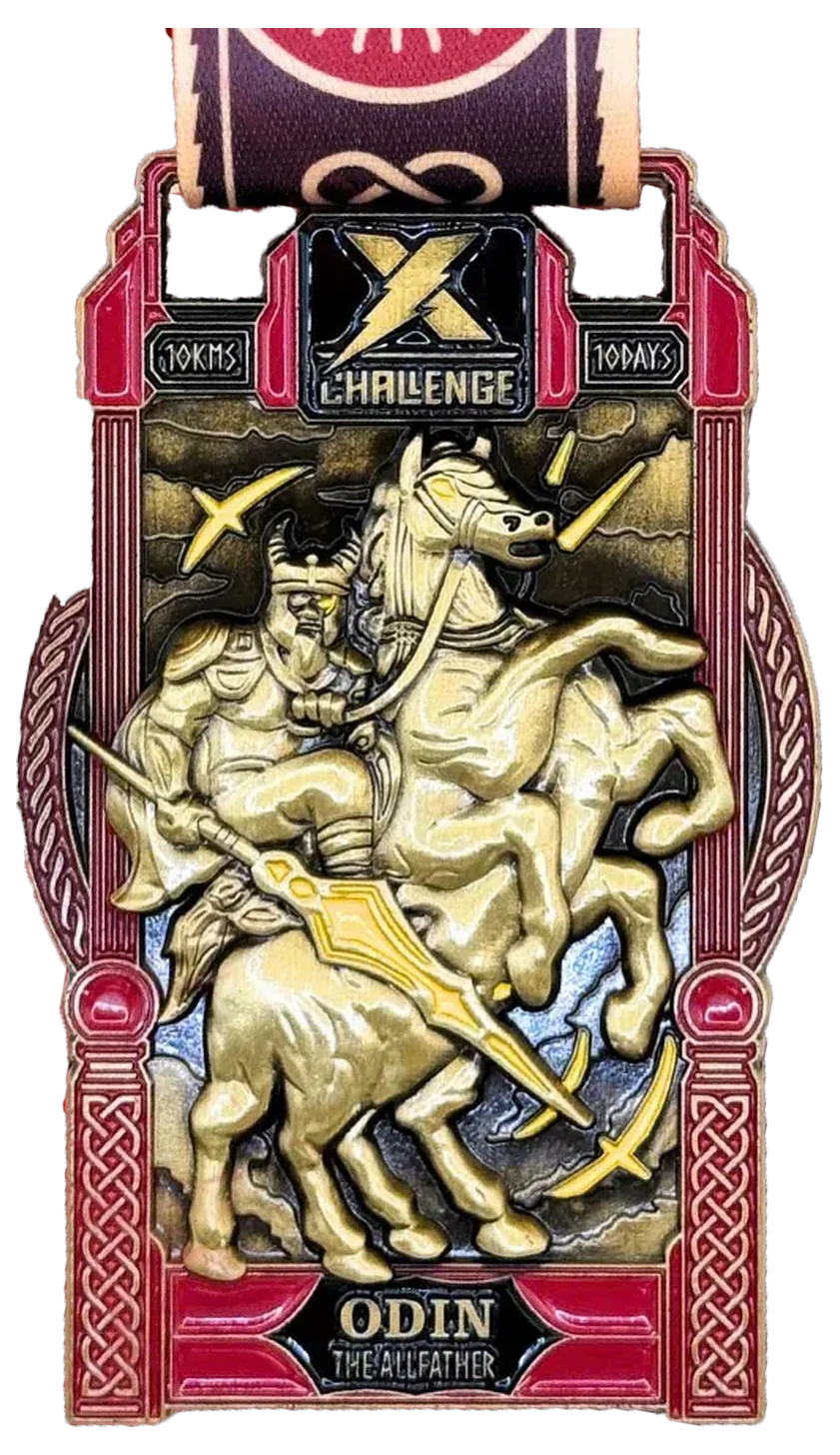
- What comes after the 5K? Many people move on to a 10K. Odin is 10 km over 10 days. See the virtual 10K guide.
Sources
- Get running with Couch to 5K, NHS: nine weeks, three runs a week with rest days between them, and a GP visit first if you are worried about your health.
- Couch to 5K running plan, NHS: the week-by-week intervals and the advice to repeat a run or a week when you need to.
- How to Measure Physical Activity Intensity, CDC: the talk test for moderate and vigorous effort.
Challenges from this guide

Or take the whole set

More: all guides · how it works · every challenge